The take
A gym sells a promise to show up. The bank is not lending against a truck or an oven. It reads your deposits, your lease, your equipment and how many members you keep. Know what your statements show before the bank does.
- ✓Prepaid dues make January look rich. On a made-up studio with 220 monthly members at $89 and 60 annual members at $890, January deposits are $72,980. The studio earns $24,030 a month. A bank that reads the January statement alone sees three times the real run rate. Show the bank the earned number.
- ✓You replace about a third of your members every year. One benchmark puts average annual retention at 66.4%, per Gymdesk, citing the Health & Fitness Association. On 280 members, that is about 94 people to win back just to stay flat.
- ✓The banks publish lines, not gym rules. Wells Fargo lists a BusinessLine up to $150,000. U.S. Bank lists Cash Flow Manager up to $250,000. Bank of America lists an unsecured line up to $250,000 and wants two years under current ownership. Chase lists lines to $500,000 for existing Chase for Business customers.
- ✓Same file. Same banks. Different order. The Bankable Blueprint™ puts the lease, the bank accounts and the deferred-revenue story first, then 0% cards for what vendors will take on a card, then equipment finance or a line when the file can carry it. Typical bank small-business cards still ask for a personal guarantee.
2. Why a gym reads differently to a bank
The fitness business is big and growing. The Health & Fitness Association says a record 81 million Americans belonged to a gym, studio or other fitness facility in 2025, which is 26.1% of the population ages six and older. The same report says churn hit a decade low. That is good news for demand. It is not good news for your file by itself, because a bank lends to a business, not to an industry.
Here is what a lender sees when your file says "fitness."
- Recurring revenue. Monthly dues are steady. That is a plus. But members can cancel, and the bank knows it.
- Cash that is not yet earned. Annual and multi-month prepayments land in your account on day one. The service is delivered over the next 12 months.
- A lease and a build-out. Most of the money goes into the space and the floor. Buildout is hard to sell and the equipment loses value. NerdWallet quotes a health club consultant putting startup costs from $30,000 to $500,000.
- A sector the SBA data flags. In an analysis of SBA 7(a) and 504 data, fitness and recreational sports centers show an 11.1% charge-off rate against 7.6% across all industries, for FY2010 to FY2019 approvals that reached a final status. A lender who has seen that number may ask for more from you. Not because of you. Because of the category.
What does this mean for an owner? The file has to answer four questions fast. Is the revenue real? Is it earned or prepaid? Can the lease and the equipment loan be paid if members leave? Who stands behind it? This guide covers each, and where a 0% round fits.
3. The January problem, in your dollars
Many gyms run annual-membership deals, often as a January push. Here is a made-up studio. Nothing about it is a real client.
| Item | Math | Amount |
|---|---|---|
| Monthly members | 220 members at $89 | $19,580 a month |
| Annual prepaid members | 60 members at $890, paid in January | $53,400 in January |
| Earned each month from annual members | $53,400 divided by 12 | $4,450 a month |
| Earned revenue per month | $19,580 plus $4,450 | $24,030 |
| Deposits in January | $19,580 plus $53,400 | $72,980 |
| Deposits in each other month | Monthly members only | $19,580 |
| Prepaid dues still owed in service at the end of June | 6 months at $4,450 | $26,700 |
Read the table twice. In January, the bank statement shows $72,980. In July, it shows $19,580. Neither is the business. The business earns $24,030 a month and owes six more months of service on $26,700 of cash already collected. If the studio spends the January cash on a new rig in February, there will be a hole in July.
The IRS has its own rule here. Per IRS Publication 538, you generally report an advance payment as income in the year you get it. An accrual-method business can elect to defer part of it to the next year, but not beyond that. That is a tax rule, not a lending rule. A bank may read the same numbers differently from your return. Ask your accountant how your tax return and your books treat prepaid dues, then bring one clear set of numbers to the lender.
The fix is simple. Keep a deferred revenue line on your balance sheet. Show earned revenue by month next to deposits. A banker who reads the bank statement guide logic will see the January spike for what it is, if you show them first.
4. Retention, in your dollars
Revenue that arrives every month looks safe. It is only as safe as the members who stay. Gymdesk reports, citing the Health & Fitness Association's 2025 benchmarking report, that the average club kept 66.4% of its members over a year. The Association's 2026 consumer report says churn reached a decade low in 2025 but gives no figure on its public page. So treat 66.4% as a planning benchmark and use your own number once you have it.
| Item | Math | Result |
|---|---|---|
| Members who leave in a year | 280 times 33.6% | About 94 |
| Dues those members were paying | 94 times $89 a month, if all were monthly | About $8,366 a month |
| New members needed to stay flat | Same as members lost | About 94 a year, or 8 a month |
That is $8,366 of monthly revenue that has to be rebuilt each year just to stand still. If your lease is $9,500 a month, the member loss in a year is most of the rent. A bank will read your member count and ask how many joined and left last year. Have the answer ready. Our Leg 4 walkthrough explains why lenders read trends before totals.
5. The lease and fixed costs, in your dollars
A gym's biggest fixed cost is the space. A lender does not treat rent as a bill you can skip. It treats rent as the first claim on your cash. Take the made-up studio from section 3, with $24,030 a month in earned revenue, and add a made-up $9,500 monthly lease and the $2,491 equipment payment from the next section.
| Item | Per month | Share of $24,030 earned |
|---|---|---|
| Lease | $9,500 | 39.5% |
| Equipment payment, 5 years at a made-up 9% | $2,491 | 10.4% |
| Lease plus equipment payment | $11,991 | 49.9% |
| Left for payroll, insurance, software, marketing and the owner | $12,039 | 50.1% |
Half of every earned dollar is gone before the first coach is paid. That is the number a banker is looking for, even if no one says it out loud. Add a 0% stack at $1,500 to $2,250 a month in required payments and the room gets tighter. This is why the plan sizes each piece of credit to the cash flow, not to the limit. A bigger limit does not make the studio earn more.
It also changes what you ask for. A longer equipment term lowers the payment. A line of credit can carry a slow month, but it costs interest when drawn. A cash reserve costs nothing to hold and is the cheapest cover you have. We plan on three months of fixed costs in cash. On these numbers, that is $35,973 for the lease and the equipment payment alone. That is a planning rule of ours, not a bank rule. If it is out of reach today, it tells you how much to draw and how fast to grow.
6. Equipment: buy, lease, finance or card
The floor is the biggest check. Racks, cardio, flooring, sound and software add up fast. NerdWallet's fitness startup guide names the options owners use: an SBA loan, a business line of credit, a personal loan and gym equipment financing. It notes that with equipment financing, the equipment is the collateral for the loan that buys it.
Collateral helps you and costs you. It helps because a lender will lend against something it can claim. It costs you because the lender takes a lien on that equipment, and the lien shows up when you ask for the next loan.
Here is the monthly cost on a made-up $120,000 equipment package at a made-up 9%. These are not quotes.
| Term | Payment per month | Payments per year | Cash flow a bank wants at 1.25 times |
|---|---|---|---|
| 5 years | $2,491 | $29,892 | $37,365 |
| 7 years | $1,931 | $23,168 | $28,960 |
The 1.25 column is a common lender yardstick for debt service coverage, not a rule from any bank on this page. Bankrate calls 1.25 or higher ideal. The longer term cuts the payment by $560 a month, and the studio pays more interest over the life of the loan. Pick the term from your cash flow, not from the lowest payment.
Lease versus buy versus finance is its own subject. Our equipment lease, buy or finance guide and the year-end equipment playbook go through the tax and cash side. Talk to your accountant before you buy for a tax reason alone.
7. What the Tier 1 banks publish
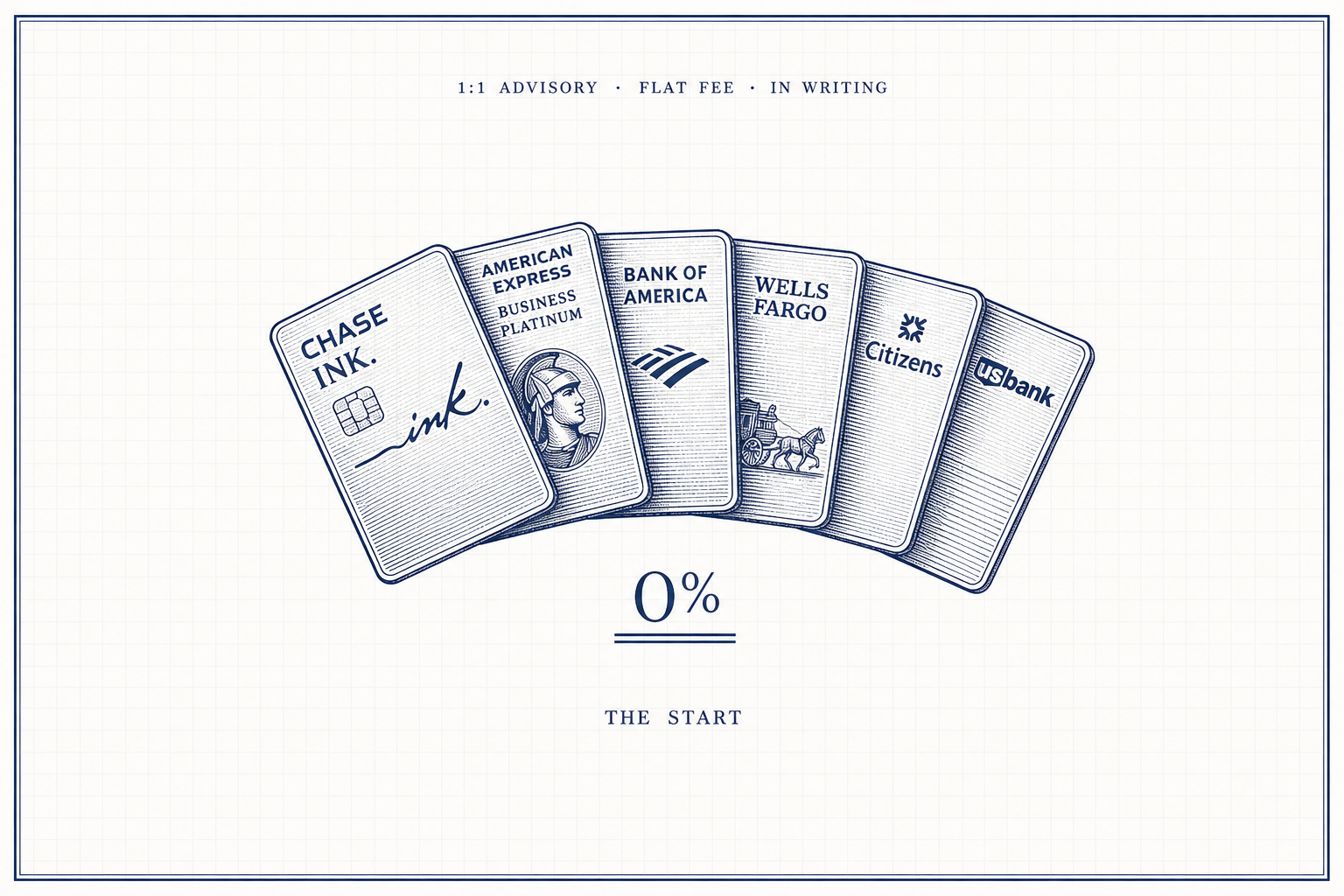
The five Tier 1 issuers are Chase, American Express, U.S. Bank, Bank of America and Wells Fargo. Four of them publish business lines of credit. Amex has its own line product, covered in a separate guide. The pages below set general rules, not gym rules. Here is what they publish for lines.
| Bank | Product and size | Published requirements | What it means for a studio |
|---|---|---|---|
| Wells Fargo | BusinessLine, unsecured, up to $150,000. Prime + 1.75% to Prime + 9.75%. | Six months or more in business. Personal guarantee from owners with 25% or more. Guarantors typically FICO 680 or better. | The newest studios can apply, but the rate range is wide. At Prime 7.00%, $100,000 drawn costs $729 a month in interest at the low end and $1,396 at the high end. |
| U.S. Bank | Cash Flow Manager, up to $250,000. Unsecured up to $100,000, per its financing page. | $0 annual fee over $50,000 and $150 at $50,000 or less. Faster decisions up to $50,000. | A $50,000 line with a $150 fee is a small, fast tool. Bigger lines take longer. |
| Bank of America | Business Advantage Credit Line, unsecured, $10,000 to $250,000 | Two years in business under existing ownership. Cash-secured line from $1,000 to $50,000 needs six months. | A studio under two years starts with the cash-secured line or waits. |
| Chase | Business Line of Credit, $10,000 to $500,000, for existing Chase for Business customers | Revenue of at least $100,000. FICO of at least 660. Majority ownership and management unchanged for two years. | You need a Chase for Business account first. A stable owner group matters. |
Do the owner math on the Wells Fargo row. Prime is 7.00% per Wells Fargo's page, so the low end is 8.75% and the high end is 16.75%. A drawn $100,000 costs $8,750 a year at the low end and $16,750 at the high end. The $8,000 gap is the price of a weaker file. That is why Legs 2, 3 and 4 matter before you apply. See the guides on Wells Fargo BusinessLine, U.S. Bank Cash Flow Manager and the Chase line. For the full path, read the line of credit requirements guide.
8. Where SBA fits
The SBA's own lender page says the 7(a) program goes up to $5 million and can fund equipment, furniture and fixtures, leasehold improvements, working capital and a change of ownership. For a gym, that list matches the three big needs: the build-out, the floor and the buyout of an existing club. The SBA guarantees part of the loan. The bank still decides and still underwrites.
The same SBA-data analysis shows how common the sector is: 17,652 loans worth $7.82 billion since FY2010, with a $240,000 median. Lenders know this category. That helps with familiarity. It also helps them price the risk. NerdWallet says that in most cases, an SBA loan wants a credit score of 650 or better, revenue of $100,000 or more and two years in business. Those are NerdWallet's general figures, not SBA rules, and each lender sets its own.
Also note what changed in 2026. The SBA no longer uses the SBSS score to screen small 7(a) loans, and lenders now rely on their own credit analysis. Our SBSS sunset guide has the details. For a studio owner, it means the bank's read of your cash flow carries more weight than a single score.
If you are buying an existing club, read the acquisition financing guide. If you are thinking about a franchise brand, see the franchise financing guide.
9. What 0% cards can and cannot carry
Cards do not buy a $120,000 rack of equipment unless the seller takes a card. Many sellers do for part of an order. Many cap the amount or add a fee. Ask before you plan around it.
Here is where a 0% round does help a studio: flooring and paint at a local supplier, software, marketing, small equipment, mirrors, sound, a refresh of the front desk, and the first months of insurance. It carries the spend that vendors take on a card, at no interest during the intro window. Round 1 is Month 3, with all five Tier 1 issuers on the same day and American Express first through the soft-pull path. Round 2 is Month 7 to 8 with four issuers, skipping Wells Fargo. Round 3 is Month 11 to 12 with all five again. The Round 1 walkthrough explains the timing.
| Spend | Amount |
|---|---|
| Flooring and paint | $18,000 |
| Marketing push | $12,000 |
| Mirrors and sound | $9,000 |
| Software and member app, first year | $6,000 |
| Front desk and furniture | $5,000 |
| Total on cards | $50,000 |
On $50,000, the required payments at 1% to 1.5% are $500 to $750 a month. To clear it inside a 12-month window, the studio has to pay about $4,167 a month. That comes out of the $12,039 left in section 5, the same pot that pays the coaches. A $150,000 draw would need about $12,500 a month, which is more than the whole pot. Draw to the number the studio can retire.
Now the cost. 0% does not mean zero monthly payment. A $150,000 stack at 1% to 1.5% a month is $1,500 to $2,250 a month in required payments. For the made-up studio earning $24,030 a month, that is 6% to 9% of earned revenue before rent or a single equipment payment. Our monthly payment system keeps that bill from eating a slow month, and the exit plan guide shows how to clear the balance before the window ends.
The five Tier 1 issuers do not report ongoing business card balances to personal bureaus. A gym owner carrying equipment on cards does not see that balance as utilization on the personal file. The application can still involve a hard inquiry, so confirm each issuer's pull policy. See the pull and report guide.
One honest limit. A studio with no revenue yet has nothing to state on an application. The revenue and income fields guide covers what issuers ask. A pre-opening gym is a startup file, and the Blueprint is built for owners who have a business history to read.
10. The four Legs, translated
- Leg 1, lender compliance. Banks check who you are before your numbers. A gym often has a landlord, a processor and an insurer on the same file, and each should match your legal name and address. Our Leg 1 walkthrough has the list. Read your lease for a personal guarantee and any landlord consent needed for improvements, and confirm the terms with your attorney.
- Leg 2, business credit scores. A studio often pays its landlord, its equipment vendor and its insurer on time. Not all of them report. The Leg 2 walkthrough shows how to check what the bureaus hold.
- Leg 3, 10 to 15 trade lines. Equipment vendors, flooring suppliers, cleaning supply and software accounts can add reporting history, if they report. Ask each one. See the Leg 3 walkthrough.
- Leg 4, financials. This is where the gym file wins or loses. Earned revenue by month, deferred revenue, a member roll, and a profit and loss that matches your tax return. Keep personal and business money apart. The commingling guide shows what banks see when you do not.
Same file. Same banks. Different order. A gym owner who has Leg 4 in shape by Round 1 has an easier conversation than one who tries to explain January at the counter.
11. Five mistakes gym owners make
- Spending the January cash. Prepaid dues are owed in service. Hold the unearned part in reserve, or you will feel it in July.
- Quoting members, not dollars. A banker wants earned revenue by month, rent plus debt service, and what is left.
- Stacking equipment liens before a line. A lien on the equipment can limit what the next lender will take as collateral. Plan the order.
- Applying under two years without a plan. Bank of America's unsecured line wants two years under current ownership. Chase wants two years of unchanged majority ownership. Know each bank's floor before you apply, so you do not burn an inquiry.
- Believing an EIN or LLC removes the guarantee. Typical bank small-business cards at Chase, Amex, U.S. Bank, Bank of America and Wells Fargo still collect owner identity details and a personal guarantee. Wells Fargo's line page says so for its line. Confirm on each issuer's page.
12. Questions gym owners ask
Do banks lend to gyms?
Yes. SBA data shows thousands of loans in the fitness category. Lenders may ask for more because the category's charge-off rate runs above the all-industry rate in the data cited here. Your own file decides your answer.
How do prepaid annual memberships affect a loan?
They raise deposits in the month you collect and leave a service obligation behind. Show the bank earned revenue by month and a deferred revenue line. Ask your accountant how your tax return treats prepaid dues, per IRS Publication 538.
Can I put gym equipment on a business card?
Only if the seller takes cards for the amount. Many cap card payments or add a fee. For larger equipment, equipment financing or an SBA loan is more common. Remember that 0% still carries a monthly minimum, about 1% to 1.5% of the balance.
How long do I need to be open before a bank will lend?
It depends on the product. Wells Fargo lists six months for its BusinessLine. Bank of America lists two years under existing ownership for its unsecured line. Chase lists two years of unchanged majority ownership. NerdWallet says SBA loans generally want two years.
Will a gym owner's lease hurt the file?
A lease is a fixed monthly cost a lender counts against your cash flow. Read it for a personal guarantee and for the rules on improvements. Confirm the terms with your attorney, and show the rent in your debt service math.
13. Open items
- Gym-specific bank rules. The bank pages cited here set general rules, not fitness rules. Ask your banker how the bank treats prepaid memberships and a lease-heavy file.
- The retention figure. 66.4% is a benchmark reported by Gymdesk from the Health & Fitness Association's 2025 report. The Association's 2026 consumer report says churn reached a decade low but gives no number on its public page. Use your own member data.
- The SBA sector figures. The 11.1% and 7.6% charge-off rates and the loan counts come from an analysis of SBA FOIA data for FY2010 to FY2019 approvals. They describe the past, not your loan.
- Line terms. Rates, limits and requirements change. Confirm each on the bank's page before you apply. Bank of America's and U.S. Bank's limits above come from their published product pages.
- Tax treatment of prepaid dues. Publication 538 is a general rule. Your accountant decides what applies to you.
- Lease terms. A personal guarantee or consent rule may sit in your lease. Confirm with your attorney.
- All studio numbers. The member counts, dues, equipment package, rates and payments are made up for illustration. They are not quotes or a promise of any result.
14. What to do next
- Today Pull 12 months of bank statements. Mark every deposit as monthly dues, annual prepay or other.
- This week Build one page: earned revenue by month, deferred revenue at month end, rent, and every loan or card payment.
- Next week Count members who joined and left in the last 12 months. Write down your own retention number.
- Next two weeks Read your lease for a personal guarantee and improvement rules. List every equipment lien.
- Before Round 1 Run the pre-application checklist. Plan the monthly payment calendar and the exit date for every 0% window.
- After Round 1 Use the file to ask for equipment financing or a line, in the order the bank wants to see it.
If you want the file read the way a bank reads it, that is what the Bankable Scan™ does.
15. Compliance
This article is educational. It describes public bank, SBA and tax-agency information and general planning methods for fitness business owners. It is not credit, legal, tax, or financial advice, not a lending offer and not a promise of approval or of any result. Results vary by file. Stacking Capital runs a 1:1 business credit and bank-readiness coaching program. We are not a bank, a lender, or a broker.
Terms change. Bank products, rates and requirements cited here are current as of November 24, 2026 and can change without notice. Studio numbers, equipment payments and interest figures are illustrations built on made-up inputs, not quotes or projections.
Approval is not guaranteed. Typical bank small-business cards from the five Tier 1 issuers still collect owner identity details and a personal guarantee. Confirm the current terms on each issuer's page before you apply.
Sources: Health & Fitness Association, 2026 US consumer report; Gymdesk, gym retention benchmarks; Funding for Businesses, SBA data for NAICS 713940; IRS, Publication 538; SBA, lender programs; Wells Fargo, business lines of credit; U.S. Bank, Cash Flow Manager; U.S. Bank, financing recommendation; Bank of America, unsecured line of credit; Chase, business line of credit; NerdWallet, starting a fitness business; NerdWallet, SBA loan requirements; Bankrate, business loan requirements.
Schedule your Bankable Blueprint Call
Bring 12 months of statements, your lease and your member counts. We map the file so a bank reads earned revenue, not a January spike.
The Bankable Scan™ reads the personal and business file the way a bank does. The Bankable Blueprint™ writes the order: compliance items, bureau capacity, the 0% doors that fit the file now, and the exit plan before the window closes. 0% is the start. Bankable is the process.
Book a Bankable Blueprint Call