The take
What this means
- ✓$500K+ in unsecured capital is accessible at 0% interest for qualified established businesses — no collateral, no equity dilution.
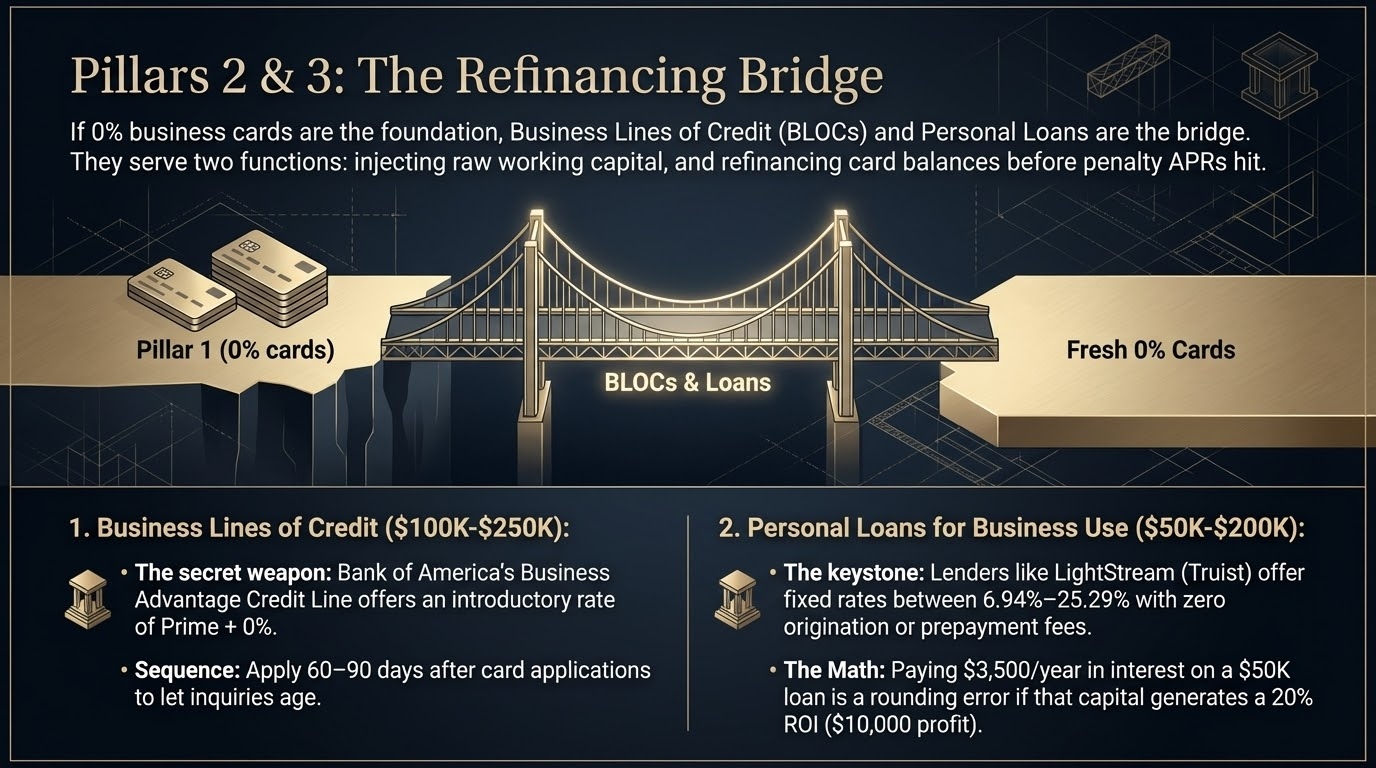
- ✓The strategy uses a three-pillar approach: 0% APR business credit cards ($150K–$250K) + business lines of credit ($100K–$250K) + personal loans ($50K–$200K).
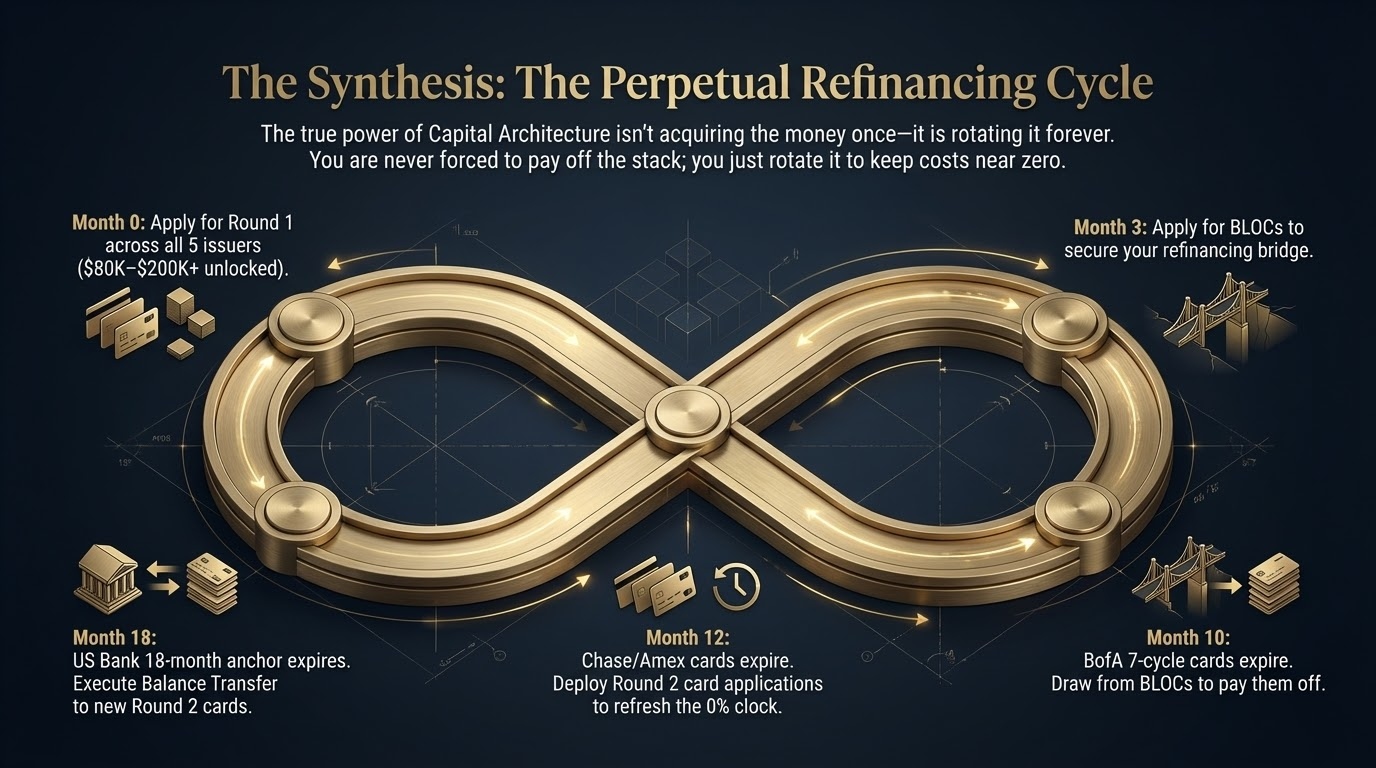
- ✓The refinancing cycle keeps capital costs near zero perpetually — you're never forced to pay off the stack, just rotate it.
- ✓Requires a "bankable" profile: 720+ FICO across all bureaus, 2+ years in business, $1M+ revenue, and existing Tier 1 bank relationships.
- ✓The US Bank Business Shield Visa at 18 billing cycles (in-branch only) is the anchor product of any serious capital stack in 2026.
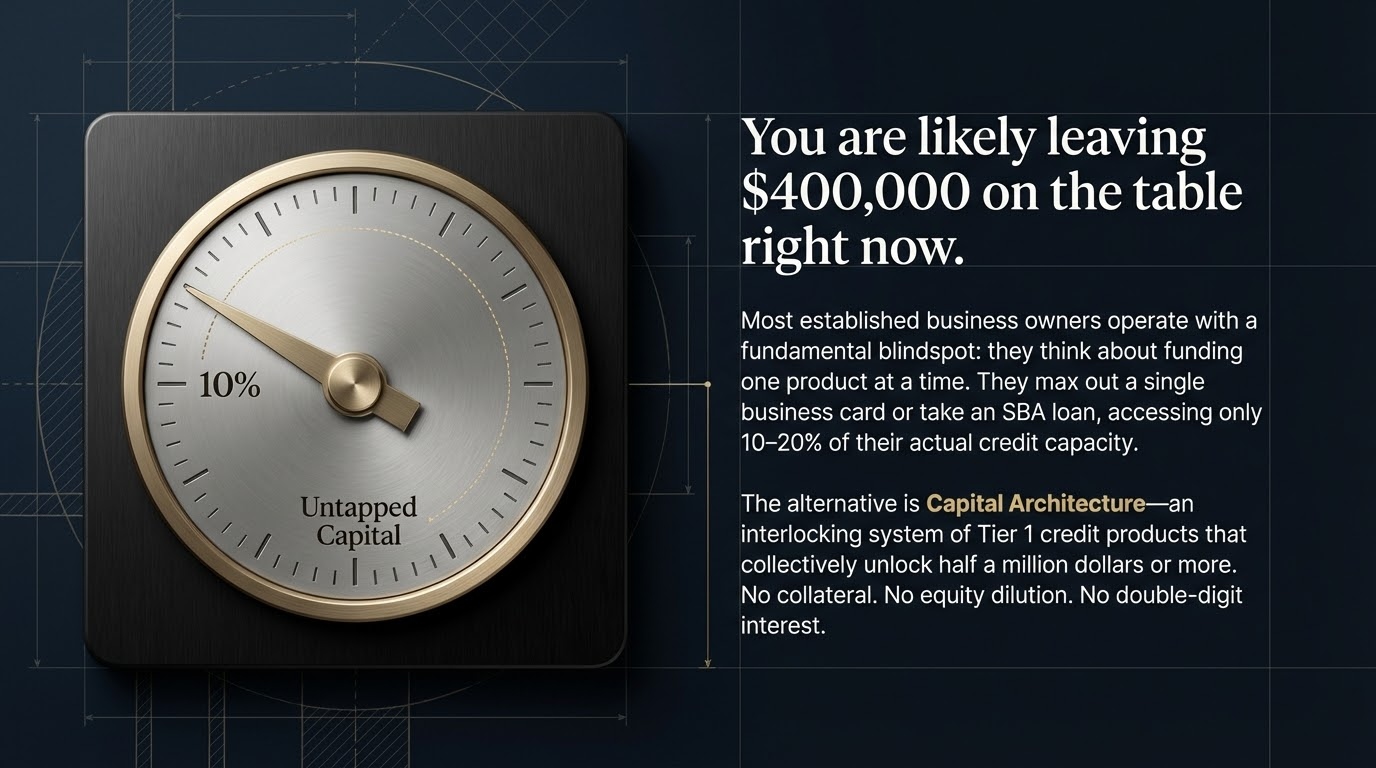
- ✓Most business owners only access 10–20% of their available credit capacity — this guide shows you how to access the other 80–90%.
- ✓All five Tier 1 issuers — Chase, BofA, Amex, US Bank, and Wells Fargo — do NOT report business cards to personal credit (unless delinquent). This is a major advantage of business credit stacking.
The Capital Architecture Framework
Most business owners think about funding one product at a time: "Should I get a business credit card?" or "Should I apply for a line of credit?" That's the wrong mental model. Capital architecture is about engineering an interlocking system of credit products that collectively give you access to half a million dollars or more — at effectively zero cost, for as long as you need it.
The three-pillar capital stack works because each pillar serves a different function and draws from different credit capacity:
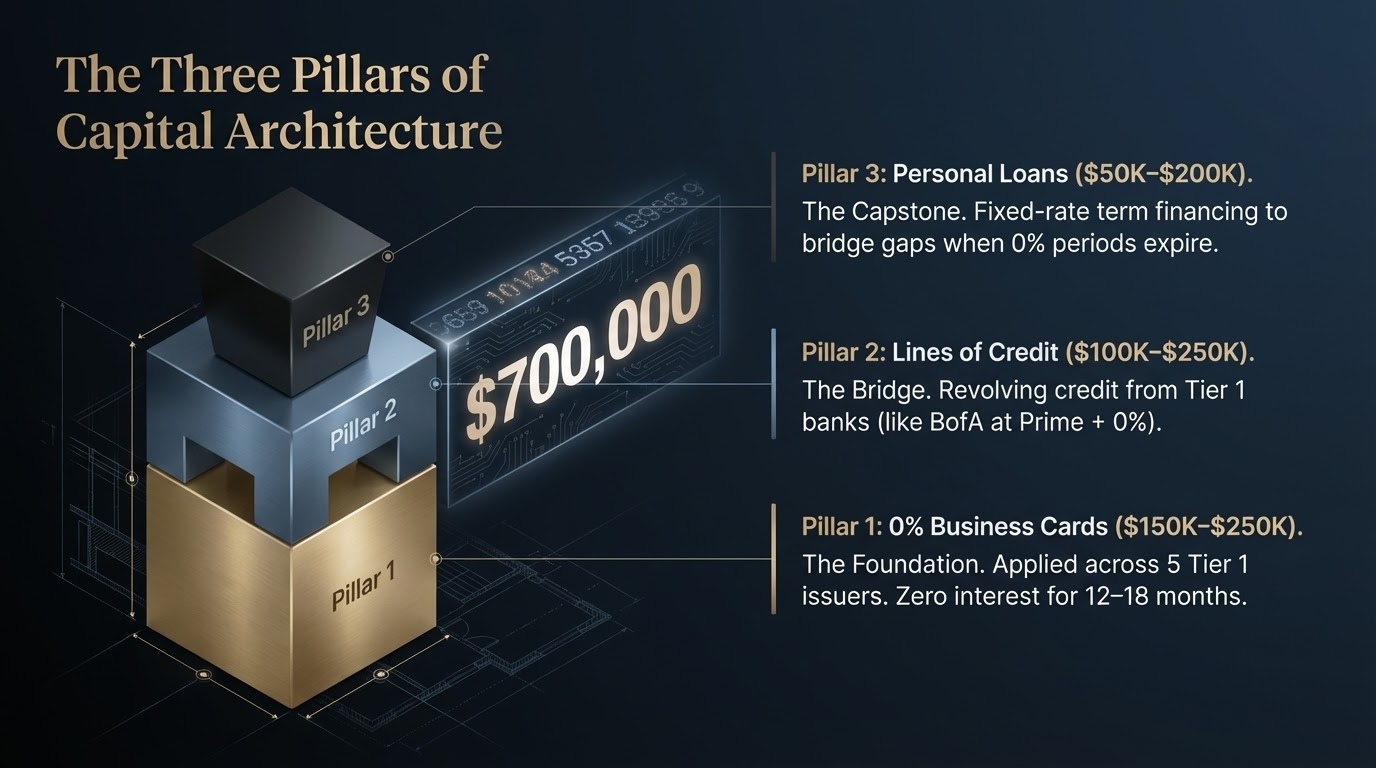
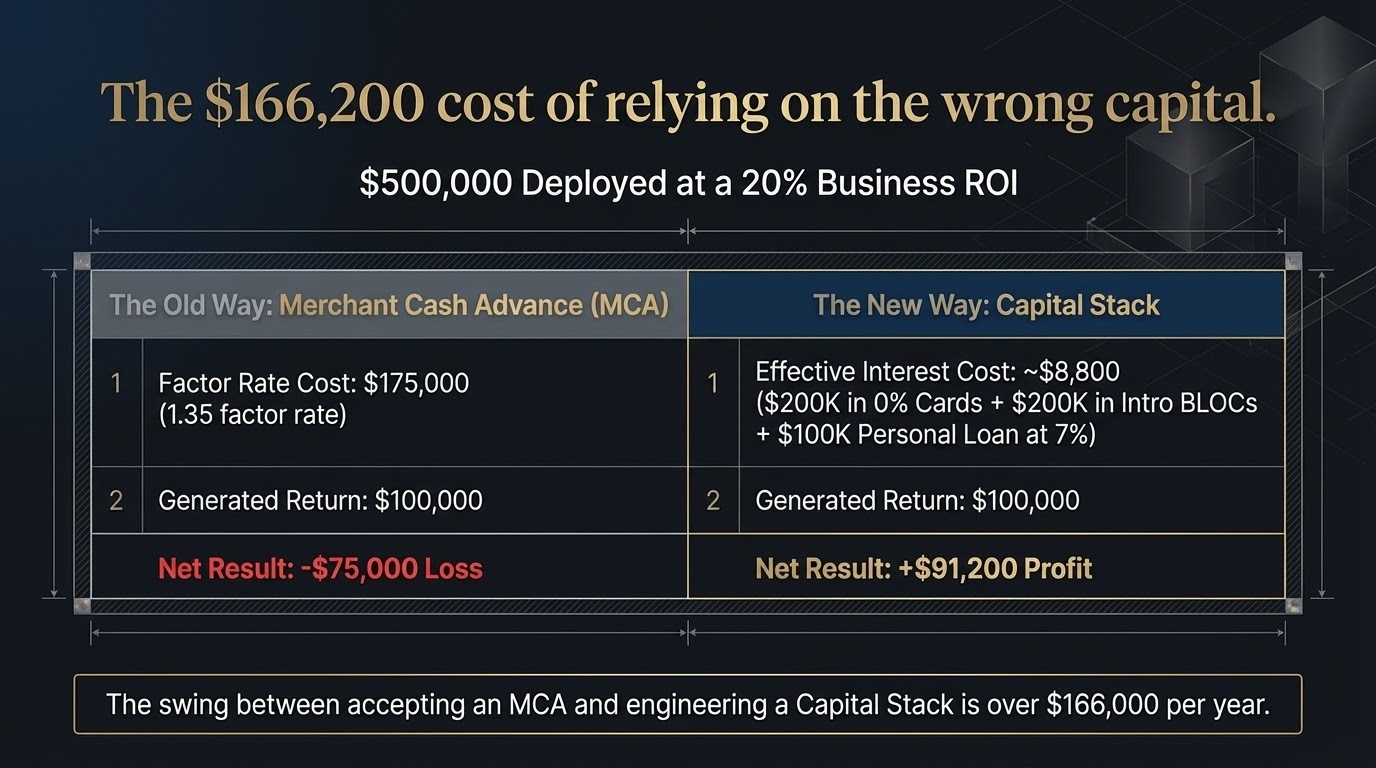
Together, these three pillars can put $300K–$700K of working capital in your hands at costs ranging from 0% to 7–12% — a dramatic improvement over the 25–50%+ effective rates most businesses accept from MCA lenders or short-term loan providers. According to Bankrate's research on unsecured business loans, the average small business loan rate in 2026 sits between 6% and 45% depending on the lender — yet qualified businesses can access the same capital at 0% with the right strategy.
The prerequisite for this strategy is being what the banking industry calls "bankable" — a profile that qualifies for Tier 1 bank products. This isn't a strategy for startups or businesses with credit challenges. It's for established business owners who have already proven their business model and are ready to scale with intelligent capital deployment.
Capital Architecture
Ready to stack your funding?
Our advisors map out the optimal combination of lending products for your business — from Chase to Amex to US Bank and beyond.
Book a Free CallPillar 1 — 0% APR Business Credit Cards ($150K–$250K)
The foundation of every capital stack. Applied strategically across five Tier 1 issuers, you can access $150,000–$250,000 in credit limits at 0% interest for 12–18 months per card.
Chase Ink Business Cards — 0% for 12 Months
Chase is the starting point for any capital stack. The Chase Ink family offers two cards with 0% intro APR periods that are tailor-made for business capital deployment. Chase typically approves $15,000–$50,000+ per card for qualified applicants, meaning a single issuer can put $30,000–$100,000 in your hands at zero cost.
- → Ink Business Unlimited®: 0% intro APR for 12 months (then 16.74%–24.74% variable), $0 annual fee, unlimited 1.5% cash back on all purchases, $900 cash back bonus after $6,000 spent in the first 3 months. Per NerdWallet's 0% business card analysis, this is among the strongest no-fee 0% offers available.
- → Ink Business Cash®: 0% intro APR for 12 months (then 16.74%–24.74% variable), $0 annual fee, 5% cash back on office supplies and internet/phone/cable services (up to $25,000 combined annually), $900 cash back bonus. The rewards structure makes this ideal for businesses with high utility and telecom spend.
For established businesses, I always start with existing bank relationships. If you have a Chase business checking account, the Ink cards should be your first applications — relationship-based underwriting consistently produces higher initial limits. I've seen clients with strong Chase banking relationships receive $40,000–$75,000 per Ink card on their first application. Apply for both the Unlimited and the Cash on the same day — Chase counts both as a single hard inquiry when submitted together. That's two cards, one pull. Chase pulls Experian, same as Amex and Wells Fargo. BofA and US Bank both pull TransUnion, making them your second bureau pair.
Credit reporting: Chase business cards do not report to personal credit bureaus unless the account becomes delinquent. Applications pull Experian in most states. Chase and Amex form your Experian pair in Round 1, while BofA and US Bank form your TransUnion pair — two pulls per bureau, then you pause to remove inquiries before the next round.