The take
Core PCE inflation came in at 3.3% for October, a tenth above the forecast, and third-quarter growth was revised up to 4.3%. The Fed meets December 8 to 9 and the futures market already expects a hike. Today's data does not change that. It makes the next hike after December harder to rule out.
- ✓The news. BEA says the October PCE price index rose 0.3% on the month and 3.8% from a year ago. Core, which drops food and energy, rose 0.3% and 3.3%. Forecasts were for about 3.8% and 3.2%, per FXStreet. BEA's second GDP estimate lifted third-quarter growth from 3.4% to 4.3%.
- ✓Prime today. Prime is 7.00% in the Fed's H.15 release, three points above the top of the 3.75% to 4.00% target range. A quarter-point hike on December 9 takes it to 7.25%. A half point takes it to 7.50%.
- ✓The dollars. On $100,000 drawn on a line that floats with Prime, a quarter point is $20.83 a month. A half point is $41.67. A full point is $83.33, or $1,000 a year. On a card balance still inside its 0% window, the move is $0.
- ✓Same file. Same banks. Different order. The Bankable Blueprint™ is built so the order of your moves does not depend on a Fed headline. A rising Prime changes what floats, not what the file needs. Typical bank small-business cards still ask for a personal guarantee, in any rate cycle.
2. What came out at 8:30 this morning
Three reports landed at 8:30 a.m. Eastern. The Bureau of Economic Analysis (BEA) published October Personal Income and Outlays and the second estimate of third-quarter GDP. The Labor Department published weekly jobless claims, moved up a day because of Thanksgiving. Here is each number, and what it means on a line, a loan or a file.
| Measure | October result | Forecast or prior | Why an owner cares |
|---|---|---|---|
| PCE price index, month | +0.3% | Forecast about +0.3% | Matches the plan. No surprise. |
| PCE price index, year over year | +3.8% | September 3.6%. Forecast 3.8% | Headline inflation is rising, not falling. That keeps the Fed on its hiking path. |
| Core PCE, month | +0.3% | Forecast +0.3% | No acceleration on the month. |
| Core PCE, year over year | +3.3% | September 3.1%. Forecast 3.2% | One tenth hotter than expected. This is the number the Fed watches most. |
| Personal income | +0.7%, or $201.8 billion | September +0.2% | Part of the jump is a one-time Medicare premium rebate. It is not a wage surge. |
| Personal spending | +0.3%, or $63.8 billion | September +0.5% | Customers are still spending, at a slower clip. |
| Real personal spending | 0.0% | After inflation, October spending did not grow. | |
| Saving rate | 4.1% | September 3.8% | Households saved a bit more. They did not spend the extra income. |
Source for the October figures: BEA, Personal Income and Outlays, October 2026. September's spending and saving figures come from BEA's September release.
Read the table from the bottom. Households are earning more and spending the same in real terms. Prices are still rising about a third faster than the Fed wants. Inflation at 3.3% core is 1.3 points above the Fed's 2% goal. For an owner, that gap is the whole story. The Fed's tool for closing it is the rate on your line.
Here is how the real-income line reads for your customers. Real disposable income, which is income after taxes and after inflation, rose 0.5% in October after falling 0.2% in September, per BEA. That is a bounce. A customer who earns a little more after inflation can keep paying for your service. A customer who loses 0.2% a month, as in September, starts to cut. If your file shows revenue per customer, this is the backdrop it sits against. Our Leg 4 walkthrough explains how a bank reads that trend.
3. The inflation trend, month by month
A single month tells you little. The five-month run tells you more. These are the year-over-year readings BEA has published since June.
| Month | Headline PCE | Core PCE | Core above the 2% goal by |
|---|---|---|---|
| June | 3.5% | 3.0% | 1.0 point |
| July | 3.4% | 3.0% | 1.0 point |
| August | 3.4% | 3.0% | 1.0 point |
| September | 3.6% | 3.1% | 1.1 points |
| October | 3.8% | 3.3% | 1.3 points |
The June to September figures are from BEA's PCE price index page and its core page. October is from today's release.
Look at the right column. Core inflation sat at 3.0% for three straight months, then moved to 3.1% and now 3.3%. The gap above the 2% goal grew from 1.0 to 1.3 points in two months. That is the wrong direction for anyone hoping the Fed might pause. It also explains why markets priced a hike before today's number came out.
Put it in dollars. Suppose your business borrows $150,000 on a line tied to Prime. The Fed cannot lower your cost until inflation is on a clear path down. While the gap grows, the pressure points the other way. A quarter-point hike on $150,000 costs $31.25 a month. Two hikes cost $62.50 a month. Three cost $93.75 a month, or $1,125 a year. None of that breaks a healthy business. It does add up, and it lands on the same line you may be counting on for payroll or inventory.
One note on what the numbers do not say. PCE is not CPI. CPI for October came out earlier this month and is the number most owners hear about. PCE is the one the Fed names as its goal measure, and the one in today's release. Both point the same way this fall. Our November 11 piece covered the CPI side.
Core versus headline, in plain words
Two numbers came out today, and owners often mix them up. The headline number counts everything people buy, including food and fuel. The core number leaves out food and energy, because those prices jump around from month to month. The Fed watches core closely because it shows the steadier trend. Today, headline PCE prices rose 3.8% from a year ago and core rose 3.3%.
The gap between them, half a point, tells you food and energy are still pushing prices up faster than the rest of the basket. If you run a restaurant, a delivery fleet or a landscaping crew, your own costs may track the headline number more than the core number. If you run a service business with mostly labor costs, core and wages matter more. Know which one looks like your cost sheet.
This matters for rates because the Fed has said inflation "remains elevated." A core number that rises from 3.1% to 3.3% in one month does not help that case. It is one reason the market already priced a hike in December. For you, the point is simple. The measure that moves the Fed may differ from the measure that moves your costs, so track both.
4. What the Fed has said, and what today changes
Start with the last decision. On October 28 the Federal Open Market Committee held the target range at 3-3/4 to 4 percent. The vote was 10 to 2. Lisa Cook and Beth Hammack voted against the hold because they wanted a quarter-point hike, per the Fed's statement. The statement said economic activity is expanding at a strong pace, spending has been resilient and inflation remains elevated.
Since then the signals have all leaned one way.
- Waller, November 18. Governor Christopher Waller told CNBC a half-point hike is probably needed in December, per CNBC. We covered that day in our November 18 piece.
- Williams, November 23. New York Fed President John Williams said inflation is "too high." He added that he would not exclude moving at consecutive meetings if that were needed, per Yahoo Finance.
- The market, November 24. The CME FedWatch Tool put the chance of a quarter-point hike in December at 98%, per CME Group.
So what does today's number change? Very little for December, because December was already priced. Here is how to think about it.
| Outcome on December 9 | Where the market stood | Prime after | Added cost per month on $100,000 |
|---|---|---|---|
| Hold | About 2% or less | 7.00% | $0 |
| Hike 25 basis points | About 98% on November 24 | 7.25% | $20.83 |
| Hike 50 basis points | A smaller share. One reading from November 17 to 19 put it at 3% to 10%. Waller has argued for it. | 7.50% | $41.67 |
The market share for a half point is from Admiral Markets and was measured before today's data. Treat it as a range, not a quote. The point for an owner is simple. The base case is 7.25%. The risk case is 7.50%. Hold is a long shot.
Now the part that changes. Williams' comment about back-to-back hikes matters more after today's core number. If the Fed hikes in December and core stays at 3.3% or higher, the next meeting is January 26 to 27, per the Fed's calendar, and 2027 dates are tentative. That is seven weeks after December. A second hike there takes Prime to 7.50% on the base case. This is why we show the paths in section 7 and not just one number.
The Fed also publishes a Summary of Economic Projections in December, with the dot plot. That document shows where each member expects rates to be at the end of 2027. If you want one date to circle, it is December 9 at 2:00 p.m. Eastern. The October 28 piece explains how to read that day.
5. The growth side: GDP, income and claims
The second report this morning is the one that tells the Fed it has room to hike. BEA says real GDP grew at a 4.3% annual rate in the third quarter. That is up 0.9 points from the 3.4% advance estimate in October, and up from 2.2% in the second quarter. The upward revision came mostly from investment and consumer spending, per BEA. The investment revision was led by software, and the consumer revision by goods, with services revised down.
| Measure | Second estimate | Advance estimate | What it says to a lender |
|---|---|---|---|
| Real GDP, annual rate | 4.3% | 3.4% | The economy is growing faster than first thought. |
| Real final sales to private domestic purchasers | 5.8% | 4.9% | Private demand, the best read on customers, is strong. |
| Current-dollar GDP | 6.2% | 5.6% | Sales in dollar terms are growing, which includes price increases. |
| Corporate profits from current production | Up $206.0 billion | Not stated | Profits rose, at a slower pace than in the second quarter. |
Why does that matter to a small business? Because strong growth is the reason the Fed can hike without worrying about a downturn. A bank reading your file in that world sees demand and also sees rising costs. It will ask whether your margins can absorb a higher rate on every floating balance you carry. We build that answer in section 13.
The labor data points the same way. First-time jobless claims were 189,000 for the week ended November 21, down 13,000 from a revised 202,000 the week before. The four-week average was 196,000, and the insured unemployment rate was 1.1%, per the Labor Department. Those are low numbers. People are not losing jobs in large numbers. A tight labor market keeps wages rising, which keeps service prices up, which is what the Fed is trying to slow.
Retail sales tell a similar story. The Census Bureau reports October sales up 0.2% from September, and up 6.8% from a year earlier, after a 0.8% rise in September, per Census. The next release is December 16. If you sell to consumers, your customers are spending more dollars than a year ago. A good share of that is price, not volume.
Put the pieces together. Inflation is above target and not falling. Growth is strong. Jobs are plentiful. That is the recipe for higher rates, not lower ones. An owner who plans around a cut in the first half of 2027 is planning against the data on the table today.
6. What the numbers mean for your own sales
Everything so far is about the cost of borrowing. The bigger question for most owners is the cost of doing business. Inflation of 3.8% is not just a rate story. It is a margin story, and a bank reads your margin before it reads your rate.
Start with a simple point. Revenue that grows 6% in a year with 3.8% inflation grew about 2.1% after inflation. On a $500,000 business that is the difference between $30,000 of new revenue and about $10,600 of real growth. A banker who sees $530,000 against $500,000 sees growth. A banker who knows prices rose 3.8% sees a business that barely grew. Be ready to show which one you are.
| Case | Revenue | Costs | Profit | Change in profit |
|---|---|---|---|---|
| Last year | $500,000 | $450,000 | $50,000 | |
| Prices up 2%, costs up 3.8% | $510,000 | $467,100 | $42,900 | Down $7,100, or 14.2% |
| Prices up 3.8%, costs up 3.8% | $519,000 | $467,100 | $51,900 | Up $1,900, or 3.8% |
Look at the middle row. A business that raises prices only 2% while costs rise 3.8% loses $7,100 of profit. That is 14.2% of the profit. It is also 5.7 times what a full-point rise in Prime would cost on a $125,000 floating line, which is $1,250 a year. For many owners the pricing decision is worth more than the Fed decision.
Now carry it to a loan file. Suppose the owner's debt payments are $34,188 a year, the same as the example in section 13. With $50,000 of profit, coverage is 1.46. With $42,900, it is 1.25. The rate did not move. The margin did, and the ratio fell most of the way to a typical lender's line. Banks read this in your profit and loss statement. A flat margin in an inflation year can look like a healthy file or a weakening one, depending on whether prices kept pace.
- If you set your own prices, review them now. A price list that has not moved since spring is a pay cut.
- If your prices are set by contracts, read the escalator clauses. Many have a date. Mark the next one.
- If you sell on thin margin, track cost per unit monthly. A bank wants to see that you know the number.
- If you buy on terms, ask your suppliers for notice before increases. A 30-day heads-up lets you reprice first.
Here is the link to the file. The bank will compare your revenue growth with inflation and your margin with last year. The year-end books playbook shows how to get those two numbers clean before you apply.
Passing a cost increase to customers
Margin is the fix that does not need a bank. Take the made-up owner with $500,000 of sales and $450,000 of costs. If costs rise 3.8% and the owner raises prices 2%, profit falls to $42,900. To hold profit at $50,000, prices must rise about 3.4%, since $450,000 of costs rising 3.8% becomes $467,100, and $50,000 of profit needs $517,100 of sales. That is a 3.4% rise on $500,000.
Few owners can raise every price by that much at once. Many raise the prices on new jobs first, then on renewals. Some add a small fuel or materials line to invoices. Whatever you do, do it before you apply for new credit, because a bank reads the last 12 months of statements. A margin that is already fixing itself looks better than one you hope will recover. Check any contract terms first, and ask your accountant how price changes affect your books.
7. Four paths for Prime
You do not need to guess the Fed's next move to plan. You need a few paths and the cost of each. Prime follows the Fed in a simple way. The Fed's H.15 release shows Prime at 7.00% with the target range at 3.75% to 4.00%. That is the top of the range plus 3.00 points. When the target moves, banks usually move Prime right after. Confirm the day on your own loan notice.
| Path | What happens | Target range after | Prime after |
|---|---|---|---|
| A. Quarter point in December | The base case in the market today | 4.00% to 4.25% | 7.25% |
| B. Half point in December | Waller's call from November 18 | 4.25% to 4.50% | 7.50% |
| C. Quarter point in December and January | The back-to-back case Williams did not exclude | 4.25% to 4.50% | 7.50% |
| D. Three quarter points by spring: December plus two more | A high-end case consistent with the 75 basis points over 12 months that futures showed on November 18 | 4.50% to 4.75% | 7.75% |
Path D comes from the futures-based projection we cited on November 18. We have not re-run it today. Use it as a stress case. Notice that paths B and C land in the same place. A half point in December and two quarter points by late January cost you the same by February. They differ only in the weeks between.
The right way to use this table is to pick the worst path you can afford and test your file against it. If the file works at 7.75%, a December hike is a nuisance. If it only works at 7.00%, the problem is not the Fed.
8. What each path costs your balances
Here is the math, per balance. The cost is simple: balance times the rate change, divided by 12 for a monthly figure. The first table shows the monthly cost of each move.
| Balance | +0.25 point | +0.50 point | +0.75 point | +1.00 point |
|---|---|---|---|---|
| $25,000 | $5.21 | $10.42 | $15.63 | $20.83 |
| $50,000 | $10.42 | $20.83 | $31.25 | $41.67 |
| $100,000 | $20.83 | $41.67 | $62.50 | $83.33 |
| $150,000 | $31.25 | $62.50 | $93.75 | $125.00 |
| $250,000 | $52.08 | $104.17 | $156.25 | $208.33 |
| $350,000 | $72.92 | $145.83 | $218.75 | $291.67 |
The second table shows the same moves over a year.
| Balance | +0.25 point | +0.50 point | +0.75 point | +1.00 point |
|---|---|---|---|---|
| $25,000 | $62.50 | $125 | $187.50 | $250 |
| $50,000 | $125 | $250 | $375 | $500 |
| $100,000 | $250 | $500 | $750 | $1,000 |
| $150,000 | $375 | $750 | $1,125 | $1,500 |
| $250,000 | $625 | $1,250 | $1,875 | $2,500 |
| $350,000 | $875 | $1,750 | $2,625 | $3,500 |
Read it for your own balance. Find the row. Then pick the column for the path you fear. On $150,000, a half-point hike is $62.50 a month, which is about the cost of one software subscription. A full point is $125 a month. On $350,000, a full point is $291.67 a month, or $3,500 a year.
Two cautions. First, these are the added cost of the rate move only. They do not include the base cost of the loan. A $100,000 line at Prime plus 3.00% costs $833 a month in interest at 10.00% today, so the quarter-point hike adds $20.83 on top. Second, the table assumes the balance stays flat. A balance you pay down costs less. A balance you keep drawing costs more.
The cleanest way to lower the cost of any hike is to lower the balance. Paying $10,000 off a floating line saves the same amount as the Fed's quarter-point move takes from $40,000. If you have idle cash earning less than your loan rate, that trade is worth a look. Ask your accountant before you move cash out of a reserve.
The next 12 months, not just one month
Monthly numbers hide how long a hike lasts. Here is the added interest over the 12 months from December 10, 2026, on a floating balance, for each path. We assume each hike takes effect the day after a Fed meeting. We use December 10 for the first. We use January 28 and March 18, 2027 for the next two meetings, per the Fed's tentative calendar. Path D is a stress case.
| Path | $50,000 | $100,000 | $150,000 | $250,000 |
|---|---|---|---|---|
| A. +0.25 point on December 10 | $125 | $250 | $375 | $625 |
| B. +0.50 point on December 10 | $250 | $500 | $750 | $1,250 |
| C. +0.25 on December 10 and +0.25 on January 28 | $233 | $466 | $700 | $1,166 |
| D. +0.25 on December 10, January 28 and March 18 | $325 | $649 | $974 | $1,623 |
Path C costs a little less than path B over the year, because the second quarter point arrives seven weeks later. Path D costs about two and a half times path A. On $100,000, that is $649 against $250. Neither number breaks a business. Both are real money, and both land on the lines that fund payroll and inventory. The cheapest fix in all four rows is the same: a smaller balance.
How big a cushion covers it
A cash cushion turns a rate change from a worry into a line item. Take a made-up owner with $250,000 on a floating line. A full point rise in Prime adds $208.33 a month, or $2,500 a year. A $5,000 cushion pays that added interest for 24 months. A quarter-point hike adds $52.08 a month, so the same $5,000 lasts about 96 months.
The cushion does not pay down the balance. It only covers the added cost. That is the point. You decide, once, how many months of added interest you want covered, then you set the money aside in a separate account. Many owners find that three to six months of added interest at a one-point rise is a calm, affordable number. Check the amount with your accountant, because your cash needs for taxes, payroll and inventory come first.
9. Which of your balances float
Not every balance moves with Prime. The first job this week is to sort yours. Here is what the banks publish.
| Product | What the lender says about the rate | Does a Prime hike reach it? |
|---|---|---|
| Wells Fargo BusinessLine, up to $150,000 | Prime + 1.75% to Prime + 9.75%, based on personal and business credit. Prime was 7.00% on the page's date. | Yes. Your rate is Prime plus your spread, so each Prime move passes through. |
| U.S. Bank Cash Flow Manager, up to $250,000 | Variable rate. Option to lock a fixed rate on existing balances. | Yes on the open balance. The lock turns a drawn balance into a fixed one. |
| Chase Business Line of Credit, $10,000 to $500,000 | Variable, indexed to Prime. Minimum payment is 1% of principal plus accrued interest. | Yes. And the 1% principal payment rises with the balance, not the rate. |
| Bank of America Business Advantage Credit Line, $10,000 to $250,000 | Offer shown as Prime + 0% introductory rate. Confirm the rate after the intro period. | The intro rate follows Prime. Ask what the rate becomes after it. |
| SBA 7(a) loan, variable | Negotiated, subject to SBA maximums pegged to Prime or an optional peg rate. | Yes if your note is variable. A fixed note does not move after it is signed. |
| Term loan or equipment loan, fixed | Set at signing. | No. A hike changes the price of the next loan, not this one. |
| 0% intro card balance | 0% for the intro window, then a variable APR. Chase Ink shows 16.99% to 24.99% variable after 12 months. | Not during the window. After it, a variable APR can move. |
Do one thing before you read on. Write down every balance you owe, the lender, and a word next to each: floating, fixed or 0%. Then add up the floating column. That total is the number the Fed can move. Everything else is safe from a December hike.
The totals matter more than they look. An owner who carries a $120,000 floating line, a $60,000 fixed equipment loan and $90,000 on 0% cards has $270,000 of debt. Only $120,000 floats. The December hike reaches that $120,000. On path A it costs $25 a month. On path D, which is 75 basis points, it costs $75 a month. That is not what keeps this owner up at night. What matters is what happens to the 0% cards when the windows end, which we cover in section 12.
Two more details from the table. First, U.S. Bank's fixed-rate lock is worth asking about before the Fed meets. If you carry a balance you do not plan to pay down this year, locking converts a floating balance to a known one. Ask the bank for the rate, any fee and what happens to the rest of the line. We cover the product in our Cash Flow Manager guide. Second, Chase's minimum payment is 1% of the principal plus interest. On a $100,000 draw that is $1,000 of principal each month before interest. A rate hike does not change that part. It adds to the interest on top. Read our Chase line guide for the rest.
The minimum payment on a line can surprise you
Rates are only half the cost of a line. The other half is the payment you must make each month. Chase says its business line has a minimum payment of 1% of the principal plus interest, per Chase's own page. Here is a made-up example with a 10.00% rate on $100,000. Interest is $833.33 for the month. One percent of principal is $1,000. The first minimum payment is $1,833.33.
If Prime rises a quarter point, the interest part goes up $20.83. The bigger number is the $1,000 of principal, which does not change with Prime. An owner who budgeted only for interest is short by a thousand dollars a month. Ask your banker for the exact payment formula on your own line, and put the full payment on your rate sheet, not only the interest.
10. A bank line, line by line
The Wells Fargo BusinessLine is a clean example because the bank prints the formula. Rates run from Prime plus 1.75 points to Prime plus 9.75 points. Where you land in that range depends on your personal and business credit. The same page lists a $175 annual fee, waived for the first year. Here is what each Prime path does to a $100,000 balance at the low end and the high end of the range.
| Prime | Low-end rate | Interest per month at the low end | High-end rate | Interest per month at the high end |
|---|---|---|---|---|
| 7.00% (today) | 8.75% | $729 | 16.75% | $1,396 |
| 7.25% (path A) | 9.00% | $750 | 17.00% | $1,417 |
| 7.50% (paths B and C) | 9.25% | $771 | 17.25% | $1,438 |
| 7.75% (path D) | 9.50% | $792 | 17.50% | $1,458 |
Two things jump out. The first is that the hike is small next to the spread. Moving from 7.00% to 7.75% Prime adds $62.50 a month at either end. Moving from the low end of the range to the high end adds $667 a month. The gap between the best file and the weakest file is more than ten times larger than the Fed's entire path D. That is why file quality pays more than rate timing. A better file does not just get approved. It sits at the cheaper end of the range for as long as the line is open.
The second is that your spread is set by your file. Wells Fargo says the rate depends on personal and business credit. It does not publish a score cutoff for each step. That is what the four Legs of Bankability are for. Lender compliance, business credit scores, 10 to 15 trade lines and financials are the parts of the file that move your spread. We walk each one in the Leg 1, Leg 2, Leg 3 and Leg 4 pieces.
Wells Fargo's page also says that guarantors typically have a FICO score of at least 680 at application, that owners with 25% or more must give a personal guarantee, and that the business needs at least six months of operating history. No LLC, no EIN and no entity structure removes the guarantee. Our BusinessLine guide goes through the product.
11. SBA loans: the cap moves with Prime
SBA 7(a) loans have rate caps that are pegged to a base rate, usually Prime. The SBA's lender page lists the maximum variable rates by loan size. A lender can charge less. It cannot charge more.
| Loan size | Maximum spread | Cap at Prime 7.00% | Cap at Prime 7.25% | Cap at Prime 7.50% |
|---|---|---|---|---|
| $50,000 or less | Base + 6.5% | 13.50% | 13.75% | 14.00% |
| $50,001 to $250,000 | Base + 6.0% | 13.00% | 13.25% | 13.50% |
| $250,001 to $350,000 | Base + 4.5% | 11.50% | 11.75% | 12.00% |
| More than $350,000 | Base + 3.0% | 10.00% | 10.25% | 10.50% |
The spreads come from the SBA's terms page. The table assumes the base rate is Prime. The SBA also allows an optional peg rate, so check your note. Real rates are negotiated and are usually below the cap.
The SBA also publishes maximum fixed rates each month. From November 1, the cap on a fixed loan is 12.0% above $250,000, 13.0% from $50,000 to $250,000, 14.0% from $25,000 to $50,000 and 15.0% at $25,000 or less, off a fixed base of 7.0%, per the SBA's rate table. The base was 6.75% in September and rose to 7.0% in October. That tells you the fixed cap resets as Prime moves. A fixed loan priced next month can cost more than one priced this month.
Fixed or variable, in dollars
Here is a made-up choice. You are offered a $200,000 loan in two flavors, and the rates are invented for the example. One is variable at Prime plus 3.00%, which is 10.00% today. The other is fixed at 11.00%. We use interest only, to keep the math plain.
| Prime path, held for the year | Variable rate | Variable interest per year | Fixed interest per year | Variable minus fixed |
|---|---|---|---|---|
| 7.00% (no hike) | 10.00% | $20,000 | $22,000 | $2,000 cheaper |
| 7.25% (path A) | 10.25% | $20,500 | $22,000 | $1,500 cheaper |
| 7.50% (paths B and C) | 10.50% | $21,000 | $22,000 | $1,000 cheaper |
| 7.75% (path D) | 10.75% | $21,500 | $22,000 | $500 cheaper |
| 8.00% | 11.00% | $22,000 | $22,000 | Even |
On these invented terms, the variable loan stays cheaper for a full year unless Prime climbs a full point, to 8.00%. After that, the fixed loan wins and keeps winning if rates keep rising. The fixed loan costs $2,000 a year more today for protection against more increases. That is the price of certainty. Whether it is worth it depends on how much of a rise you can afford, not on what you think the Fed will do. If a one-point rise would break your cash flow, the extra $2,000 is an insurance premium. If it would not, you may keep the savings.
One more change this year. The SBA stopped using the SBSS score on small 7(a) loans on March 1, 2026, and lenders now rely on their own credit analysis, with a required debt service coverage ratio of at least 1.1 to 1. Our SBSS sunset guide has the details. Rising rates push that ratio, which we cover next.
12. Your 0% window on a rising path
This is the section most owners need most. A 0% card does not have a Prime problem during its window. It has a window problem. The December hike does not touch a balance sitting at 0%. What touches it is the day the window ends.
Two published windows set the pace. Chase Ink Business Unlimited and Ink Business Cash each show 0% for 12 months from account opening, then a variable APR of 16.99% to 24.99%. Bank of America's Travel Rewards page states 7 billing cycles. Confirm the live terms on your own offer, since they change.
The cliff, in dollars
What happens to a balance left behind when the window ends? Here are three balances, at the low and high ends of Chase's published range and at a made-up 20%.
| Balance left | At 16.99% | At 20.00% | At 24.99% | Added by a 0.25 point hike |
|---|---|---|---|---|
| $36,500 | $516.78 | $608.33 | $760.11 | $7.60 |
| $50,000 | $707.92 | $833.33 | $1,041.25 | $10.42 |
| $98,000 | $1,387.52 | $1,633.33 | $2,040.85 | $20.42 |
Look at the last column and the first three side by side. A quarter-point hike adds $10.42 a month to a $50,000 balance. Leaving that balance behind when the window ends adds $708 to $1,041 a month. The cliff is 68 to 100 times bigger than the hike. If you are worried about the Fed and you have a 0% window closing in the next 12 months, fix the window, not the headline.
How do you fix it? Pay the balance down on a schedule from the first month. Take the balance, divide by the months left in the window and pay that much each month on top of the minimum. A $50,000 balance with 12 months left needs $4,167 a month to reach zero. With 7 cycles left on a Bank of America card, a $36,500 balance needs $5,214 a month. These are not small numbers. They are why we size the draw to the paydown, not to the limit. Our exit plan guide and the Menard exit math case study go through a full schedule.
Remember that 0% does not mean zero monthly payment. A $150,000 stack at 1% to 1.5% a month is $1,500 to $2,250 a month in required payments, even inside the window. The monthly payment system keeps those dates in one place.
What a hike does to the decision to start
If you are planning Round 1, the hike does not change the 0% rate on the offers you get. It changes the cost of leaving a balance behind after the window. The Blueprint's rounds run on the same schedule in any rate cycle. Round 1 is Month 3, with all five Tier 1 issuers on the same day and American Express first through the soft-pull path. Round 2 is Month 7 to 8 with four issuers, skipping Wells Fargo. Round 3 is Month 11 to 12 with all five again. Same file. Same banks. Different order. Read the Round 1 walkthrough for the timing.
Here is what does shift in a rising-rate year. The exit plan matters more, because the rate you land on after the window is higher. Size each draw to what you can retire before the window ends. And if you hold balances on floating lines, pay those down first. A line at 10.00% costs more than a card at 0%, so the first dollar of spare cash goes to the line, unless a 0% window ends sooner. Then that card comes first.
The five Tier 1 issuers do not report ongoing business card balances to personal bureaus. That is true in any rate cycle. It does not mean the balance is free. It means the cost shows up in your cash flow and your payments, not on your personal credit file. See the pull and report guide.
A paydown calendar you can copy
Here is a made-up $50,000 balance on a card whose window ends in 12 months. A payment of $4,166.67 a month clears it on time. The table shows where the balance should stand along the way.
| After month | Balance left | Share paid |
|---|---|---|
| 3 | $37,500 | 25% |
| 6 | $25,000 | 50% |
| 9 | $12,500 | 75% |
| 12 | $0 | 100% |
If you fall one month behind, you do not pay the cliff on all $50,000. You pay it on what is left. Be one month late with $4,166.67 still owing at 20%, and the first month of interest is about $69. That is why a calendar works better than a promise. Check the balance at months 3, 6 and 9. If you are behind at month 6, you still have time to fix it. If you find out in month 12, you do not.
13. What a rising path does to your coverage ratio
Banks do not just ask what your rate is. They ask whether your cash flow covers your debt payments. That test is the debt service coverage ratio, or DSCR: cash flow available to pay debt, divided by the debt payments due. On 7(a) Small Loans, SBA says the ratio must be at least 1.1 to 1, per its procedural notice. Bankrate calls 1.25 or higher ideal. Each lender sets its own number.
Rising rates push the bottom half of that ratio up on floating debt. Here is a made-up owner who sits right at 1.25 today. Operating cash flow is $42,700 a year. Term payments are $22,000 a year. The owner also carries a $125,000 line, drawn, at Prime plus 2.75%, which is 9.75% today. We treat the line as interest only.
| Prime move | Line rate | Line interest per year | Total debt service | DSCR |
|---|---|---|---|---|
| Today | 9.75% | $12,188 | $34,188 | 1.25 |
| +0.25 point | 10.00% | $12,500 | $34,500 | 1.24 |
| +0.50 point | 10.25% | $12,813 | $34,813 | 1.23 |
| +1.00 point | 10.75% | $13,438 | $35,438 | 1.20 |
A quarter point moves the ratio from 1.25 to 1.24. That is nothing. A full point moves it to 1.20. If the lender's line is 1.25, the owner is now short. To hold 1.25 at a full point higher, cash flow would need to be $44,297 a year, or $1,597 more than today. The quarter point is not a problem. A year of hikes can be.
What does an owner do with that? Three moves, in order of cost. First, pay down the floating line. Every $10,000 you retire cuts line interest by about $975 a year at 9.75%. Second, lock a rate where the lender allows it, as U.S. Bank's fixed-rate option does on existing balances. Third, raise cash flow, through price, cost or a cleaner cash cycle. None of the three needs a prediction about the Fed.
The same math runs the other way when you apply for a new loan. A bank will test your ratio at today's rates. A cautious one may test at a higher rate too. Ask the banker how the bank tests. Then run your own file at one point higher. If it still passes, you are in a stronger spot than most. Our line of credit requirements guide lists what banks ask for, and the bank statements guide shows how the cash flow gets read.
Two ways to repair a thin ratio
Go back to the made-up owner with $42,700 of cash flow, $22,000 of term payments and a $125,000 line at 9.75%, interest only. At one point higher, the line costs 10.75%, or $13,437.50 a year. Total debt service is $35,437.50, and coverage falls to 1.20. To get back to 1.25, you can raise the top number or lower the bottom one.
The first way is more cash flow. The owner needs $44,297, which is $1,597 more a year, or about $133 a month. That could come from a price change or a cost cut. The second way is less debt. To hold 1.25, debt service must be $34,160 or less. That means interest of $12,160 on the line, which at 10.75% is a balance of about $113,116. A paydown of about $11,884 does it. Either fix is worth more than guessing. And you can do both in part. Pay down $6,000 and find $65 a month, and you land in the same place.
14. Fixed-rate borrowing and the 10-year yield
Prime moves when the Fed moves. Longer rates move on their own clock. The Fed's H.15 release shows the 10-year Treasury at 4.92% and the 2-year at 4.63% on November 23. Before this morning's report, Tradeweb quotes cited by Morningstar had the 2-year at 4.630% and the 10-year at 4.863%. We did not take a post-release reading.
Why does an owner care? Because fixed-rate loans are priced off something. Some lenders price off Prime. Some price off Treasury yields or another index. A quote that sounds fixed may be tied to an index until it closes. Ask each lender this question: what is this rate tied to, and until what date is it held?
| Quote type | What it follows | What a December hike does |
|---|---|---|
| Variable, Prime plus a spread | Prime, and so the Fed's target range | Raises your rate the day Prime moves. |
| Fixed at closing, priced off Prime | Prime until the day you sign | Raises the rate you are offered if you have not closed. |
| Fixed, priced off a Treasury yield | Longer-term yields | Depends on the yield, which can move up or down on the news. |
The practical lesson is to close on a quote you like before the quote moves. A $200,000 fixed loan that rises from 11.00% to 11.25% before you close costs $500 more a year in interest on an interest-only basis. That is $41.67 a month. If the loan is five years, you pay it five times. This is not a reason to rush a loan you do not need. It is a reason to know your deadline when you do.
The SBA's published maximum fixed rates also move. From November 1, the cap was 12.0% on loans above $250,000, off a base of 7.0%. The base was 6.75% in September. Ask your lender which rate it is quoting and what it ties to.
Financing equipment before year-end
Year-end is when many owners buy equipment. The rate on the loan can move between the quote and the signing. Here is a made-up example. An owner finances $60,000 over 60 months. At 9.00%, the payment is $1,245.50 a month, or $74,730 over the term. At 9.50%, the payment is $1,260.11 a month, or $75,607. The half-point difference costs $14.61 a month and $877 over five years.
That is small next to the price of the machine. It is also free to avoid if the lender will hold the quote. Ask for the quote in writing, ask how long it is good for, and ask what happens if the rate changes before closing. A fixed loan locks the number at signing. A variable loan does not. Our year-end books playbook covers the paperwork a lender will ask for. Talk to your accountant about the tax side of any purchase, because that depends on your own return.
15. Thanksgiving week: payment dates and cash
This is the one section that has nothing to do with the Fed. It can still cost you money. Thursday, November 26 is Thanksgiving. The Federal Reserve Banks are closed that day. Federal Reserve Financial Services says FedACH processing ends November 25 at 11:30 p.m. Eastern and resumes November 26 at 5:30 p.m. Eastern, with a third file delivery starting at 8:15 p.m. In plain terms, ACH payments move on a thin schedule around the holiday, and a payment you set for Thursday or the days right after may post later than you expect.
What should an owner do? Here is the short list.
- Pay anything due November 26 or 27 today. A payment made on the due date does not always post on the due date, and a holiday adds a day. Each lender has its own cutoff time. Confirm yours on the statement or in the app.
- Check the autopay dates. An autopay set for the 26th may run on the 27th or the following Monday. If the date matters, move it up a week.
- Check your payroll and tax deposits. If you pay staff or make a tax deposit by ACH, confirm the date it settles. A holiday can move it.
- Keep a cash cushion through the weekend. Many businesses see big deposits over Black Friday weekend, and the money may not be available at once. Do not spend it before it clears.
Now a word on holiday spending. A 0% card does not charge interest in its window, but it does set a minimum payment from the new balance. Say your business charges $10,000 of holiday inventory and ads to a 0% card between now and December 1. At 1% to 1.5% a month, that adds $100 to $150 to the required payment on the next statement. At the same time, it adds $10,000 to the balance you need to retire before the window ends. If the card has 8 months left, that is $1,250 a month of paydown on top of the minimum. A big promotion needs a big payoff plan.
A quick rule about personal cards. Personal cards report balances to personal credit bureaus. A large holiday balance on a personal card can show up as high utilization on the file a bank reads later. That is one more reason to keep business spending on business cards and personal spending on personal cards. See the commingling guide for what banks see when the two mix.
Planning to apply for credit this week or next? Do not let the holiday decide for you. Run the pre-application checklist, then pick a date based on your file, not on the calendar. Round 1 starts at Month 3, and the clock does not care about Black Friday.
A short cash checklist for the holiday week
Use this list on Wednesday or Thursday morning. It takes ten minutes.
- List every payment due between November 25 and December 1. Include loans, cards, lines, payroll taxes and rent.
- Move any payment that matters to a due date before Thursday, or pay it today. Do not count on a Thursday or Friday transfer posting on time.
- Check your balance for the weekend. Sales may be slow or fast, depending on your business, so plan for the slower case.
- Write down the date each 0% window ends in the next 90 days.
- Put the December 4, 9 and 10 dates on your calendar.
The goal is not to react to the news. It is to enter December with no surprises on the calendar and no payment that depends on a bank being open on a day it is closed.
16. What the 2:00 p.m. Beige Book can add
The Fed publishes the Beige Book at 2:00 p.m. Eastern today, per the Fed's calendar. We wrote this piece before it was released. The Beige Book is a collection of reports from each of the twelve Federal Reserve districts, with comments from business contacts and bankers. It does not move rates. It does give you the Fed's own read on how businesses and lenders feel.
Here is what to look for when it comes out, and what each item means on your file.
| What to read | What it can tell you | What to do with it |
|---|---|---|
| Comments on credit conditions and loan demand | Whether lenders describe tighter or looser standards | If districts report tighter standards, plan for more documents and a longer review. Start your file earlier. |
| Comments on prices and input costs | Whether firms say they are passing on costs | If customers accept price increases in your area, you may keep your margin. If not, your cash flow is the one that gets squeezed. |
| Comments on wages and hiring | Whether labor is still tight | Tight labor keeps wages up, which keeps service prices up, which keeps the Fed hawkish. |
| Comments on small business and consumer spending | Whether customers are pulling back | A pullback shows up in your sales before it shows up in a bank's model. Watch your own weekly numbers first. |
One honest limit. The Beige Book is anecdotal. It tells you what contacts said, not what the data show. Use it to color your plan, not to set it. Our pre-application checklist works the same way in any report week. A weak file does not get stronger because a report reads kindly.
17. How to read December 9
The Fed will publish three things on December 9 at 2:00 p.m. Eastern: the statement, the vote and the Summary of Economic Projections with the dot plot. Here is what to look for in each, and which of the four paths it points to.
| Item | If you see this | It supports | What to do |
|---|---|---|---|
| The decision | Quarter-point hike | Path A or C | Prime moves to 7.25%. Update your rate sheet. |
| The decision | Half-point hike | Path B | Prime moves to 7.50%. Re-run your DSCR at one point higher. |
| The decision | Hold | None of the four | A surprise. Prime stays at 7.00%. Do not stop the exit plan. |
| The vote | Dissents for a larger hike | B, C or D | The next meeting is live. Plan for a second move on January 27. |
| The vote | Unanimous | A | A clear consensus. The pace after December is the question. |
| The dot plot | Median shows more hikes in 2027 | D | Treat 7.75% Prime as a base case, not a stress case. |
| The dot plot | Median shows a pause after December | A | Rates may hold in 2027. Keep your plan the same. |
| The statement | Language that inflation is still elevated | All paths | This was the October wording. A change would be news. |
The October 28 statement said inflation remains elevated and that the Committee will deliver price stability, per the Fed. If December keeps that wording and adds a hike, that is the base case. If December drops the "elevated" language, that is the first sign the Fed sees the end.
Here is how to use all this without trying to predict anything. On December 9 at 2:15 p.m., ask three questions. Did the rate move as I planned? Did the vote or the dots change the path? Does my rate sheet still work at the new Prime plus one point? If the answer to the third is yes, you are done for the day. If no, you have a to-do list, and it is the same list as section 13: pay down, lock or raise cash flow.
What to do on December 10
The day after the decision, banks begin to move. Many lenders change their Prime rate the next business day, and the December 10 CPI report lands the same morning. That is a lot of news at once. Keep it simple. Open your rate sheet, change the Prime number, and read the new monthly cost of each floating balance. Then look at the next 0% window on your calendar and ask whether the plan still holds. If it does, close the sheet and go back to work. If it does not, call your banker that week, not that month. Early calls get more options than late ones, and a prepared owner gets a faster answer. Confirm your own rate change date with your lender, because each contract is different.
18. Four owners, four plans
The numbers above matter only if they change what you do. Here are four types of owner and what each should do this week. All the examples are made up.
Owner 1: a drawn line, floating
You carry $150,000 on a line tied to Prime. A quarter-point hike costs $31.25 a month. A full point costs $125. The cost of waiting is small. The cost of ignoring the line is larger, because a balance that stays at $150,000 for a year at 10% costs $15,000 in interest.
- Write the rate, the index and the spread from your loan paper.
- Ask if a fixed-rate lock is available on the drawn balance, and what it costs.
- Set a paydown target for the next 90 days. Retiring $20,000 cuts about $2,000 a year in interest at 10%.
- Run your DSCR at one point higher. If you pass, move on. If you do not, build the plan from section 13.
Owner 2: a 0% stack, mid-window
You have $98,000 on cards that flip in five months. A December hike changes nothing today. The window does. At 20%, $98,000 left behind costs $1,633 a month. To clear it in five months, you need to pay $19,600 a month. That is probably more than your cash flow allows.
- List each card, its balance and its window end date.
- Rank the cards by end date. Pay the earliest first.
- Decide the source of the paydown: cash flow, a sale, a refinance or a line. Name it.
- If the numbers do not work, say so now. A planned shortfall costs less than a surprise one. Read the exit plan guide.
Owner 3: planning Round 1
You are about to build a file for a 0% round. The hike does not change the 0% rate on offers you get. It does raise the price of a balance you cannot retire. Size the draw to the paydown. Use $50,000 as an example. At 12 months, you need $4,167 a month. At a made-up 25% draw on a $200,000 stack, you owe $50,000, and the stack costs $500 to $750 a month in required payments (1% to 1.5%).
- Build the four Legs first. Lender compliance, business credit scores, 10 to 15 trade lines and financials.
- Do not start Round 1 until the file is ready. A date is not a reason.
- Plan the exit before the first application, not after the approvals.
- Remember that typical bank small-business cards still ask for a personal guarantee. An EIN or LLC does not remove it.
Owner 4: shopping for an SBA or term loan
You want a loan in the next 90 days. The hike raises the cost of a variable loan and the cap on a fixed one. A made-up $200,000 loan at Prime plus 3.00% costs $20,000 a year in interest today. A full point higher costs $22,000. A fixed loan at 11.00% costs $22,000 a year in interest on $200,000, interest only, and that number does not change.
- Ask each lender to quote both fixed and variable, with the spread and the index.
- Run the table in section 11 with the real numbers.
- Ask how the lender tests debt service, and at what rate.
- Do not stack a dozen applications into one week. Our credit score guide explains what lenders read.
A one-page rate sheet, filled in
Here is the sheet from the to-do list, filled in for a made-up owner. Copy the columns, not the numbers.
| Balance | Lender and type | Rate formula | Rate today | Added per month at +0.25 point | Added per month at +1.00 point |
|---|---|---|---|---|---|
| $125,000 | Bank line, floating | Prime + 2.75% | 9.75% | $26.04 | $104.17 |
| $60,000 | Equipment loan, fixed | Fixed at signing | 9.00% | $0 | $0 |
| $90,000 | 0% cards, window open | 0% until the window ends | 0% | $0 until the window ends | $0 until the window ends |
| $40,000 | SBA loan, variable | Prime + 4.00% | 11.00% | $8.33 | $33.33 |
| $315,000 | Total | $34.37 | $137.50 |
This owner has $315,000 of debt. Only $165,000 of it floats. A full-point rise in Prime costs $137.50 a month, or $1,650 a year. The $90,000 on 0% cards costs nothing extra until its windows end. Then it costs a lot more than $137.50, which is why the 0% column has the longest note. A rate sheet like this takes an hour to build. It tells you more about your exposure than any headline.
Six questions for your banker
If you carry a floating balance or plan to borrow, call your banker this week. A banker who knows your file can answer in minutes. Ask these.
- What is my rate formula, and what index does it use?
- On what date does the bank change my rate after the Fed moves?
- Can I lock a fixed rate on part of my drawn balance, and what does it cost?
- When does my line come up for renewal, and what would change at renewal?
- How does the bank test my debt service coverage, and at what rate?
- If I apply for a new line or loan before year-end, what do you need from me and how long does it take?
Write the answers on the rate sheet. A banker who sees a prepared owner remembers it. And answers to questions three and five can save you hundreds a year. Our line of credit guide lists what banks ask for in return.
If you are not in any of the four groups, you may have no debt to float and no window to fear. That is a strong place to be. It is also a good moment to build the file, because banks are open to well-prepared owners in any rate cycle.
19. The dates that matter
Here is the calendar from today to the next FOMC decision, and a few dates after.
| Date | Event | Why it matters to you |
|---|---|---|
| Wednesday, November 25, 2:00 p.m. ET | Beige Book | The Fed's read on credit conditions and prices, district by district. |
| Thursday, November 26 | Thanksgiving. Federal Reserve Banks closed. | ACH payments move on a thin schedule. Pay early. |
| Tuesday, December 1 | Job openings report for October (BLS, 10:00 a.m.) | A read on how tight labor is. |
| Friday, December 4 | November jobs report (BLS, 8:30 a.m.) | The last big labor print before the Fed decides. |
| Tuesday and Wednesday, December 8 to 9 | FOMC meeting. Decision December 9 with projections. | Sets Prime for your floating balances. |
| Thursday, December 10 | November CPI (BLS, 8:30 a.m.) | The first inflation print after the decision. |
| Tuesday, December 15 | November producer prices (BLS) | A read on costs further up the supply chain. |
| Wednesday, December 16 | November retail sales (Census, 8:30 a.m.) | A read on customer spending. |
| Tuesday and Wednesday, January 26 to 27 | The next FOMC meeting. 2027 dates are tentative. | The next chance for a second hike. |
The BLS dates are from its December 2026 schedule. The FOMC dates are from the Fed's calendar. The retail sales date is from Census.
Here is how to use the calendar. Between now and December 9, only two things can change the decision: the jobs report on December 4 and anything the Fed's speakers say. After December 9, the November CPI on December 10 is the first print that tests whether the hike is doing its job. The December 9 projections also show where Fed members see rates a year from now. If those dots show more hikes in 2027, path D moves from stress case to base case.
The December 4 jobs report, in three outcomes
The November jobs report on December 4 is the last big labor print before the Fed decides. We do not know what it will show. Here is how to think about three outcomes. This is a planning view. It is not a forecast.
| Outcome | What it could do to the odds | What it means for a $100,000 floating balance |
|---|---|---|
| Strong jobs, rising wages | Keeps a hike near certain and raises the chance of a larger one | Plan for 7.50% Prime. Added cost $41.67 a month. |
| In line with recent months | Little change. Hike stays the base case. | Plan for 7.25% Prime. Added cost $20.83 a month. |
| Clearly weak | Could lower the odds of a larger hike. A quarter point stays likely given 98% pricing. | Plan for 7.25% Prime. A cut is not on the table. |
The key row is the last one. With 98% priced for a hike, even a weak jobs report is unlikely to flip the outcome. A weak report matters more for what comes after December than for December itself. This morning's claims report, 189,000 for the week ended November 21, points to a tight labor market. That is why we lean toward the first two rows.
What should you do on December 4? Nothing new. If you did your rate sheet, you already know the cost of each outcome. The only step is to update the sheet after the decision on December 9.
20. Five mistakes this week
- Drawing early to beat the hike. On a floating line, drawing today does not lock today's rate. You pay more for money you do not yet need. Draw when you need it.
- Treating one print as a signal. A tenth of a point on core PCE does not move your rate. The string of prints and the Fed's reaction do. Plan for the path, not the day.
- Ignoring the 0% cliff because the hike looks small. A quarter-point hike adds $10.42 a month on a $50,000 balance. A balance left behind after the window adds $708 to $1,041. Spend your time on the bigger number.
- Waiting for a cut. Core inflation is 3.3% and growth is 4.3%. Both point to higher rates, not lower. A plan that needs a cut is a plan that needs luck.
- Believing an EIN or LLC changes the guarantee. Typical bank small-business cards at Chase, Amex, U.S. Bank, Bank of America and Wells Fargo still collect owner identity details and a personal guarantee. Wells Fargo's line page requires one from owners with 25% or more. Confirm on each lender's page.
21. Questions owners ask
What did today's PCE report show?
BEA reports that the October PCE price index rose 0.3% on the month and 3.8% from a year earlier. Core PCE, which excludes food and energy, rose 0.3% on the month and 3.3% from a year earlier. Personal income rose 0.7% and spending rose 0.3%, with real spending flat.
Will the Fed raise rates in December?
The CME FedWatch Tool put the chance of a quarter-point hike at 98% on November 24. The Fed decides on December 9. Nothing here is a forecast. Plan for 7.25% Prime as the base case and test your file at 7.50%.
What is Prime, and when does it change?
Prime is 7.00% in the Fed's H.15 release, three points above the top of the 3.75% to 4.00% target range. Banks usually move Prime right after the Fed moves the range. Your loan notice names the date your rate changes.
Does a hike raise the cost of my 0% card?
Not during the 0% window. After it ends, the APR is variable. Chase's Ink cards show 16.99% to 24.99% variable after 12 months. The window end date matters far more than a quarter-point move.
Should I lock a fixed rate before the Fed meets?
It depends on what you can afford if rates keep rising. U.S. Bank's Cash Flow Manager offers an option to lock a fixed rate on existing balances. Ask each lender what a lock costs and which balances it covers. A fixed loan in our made-up SBA example cost $2,000 a year more than variable at today's rates.
Is it a bad time to apply for credit?
Not by itself. 0% offers keep their 0% rate through the window. A rising-rate year raises the cost of balances you cannot retire, so the exit plan matters more. Apply when your file is ready, not when the Fed is quiet.
What if my payment is due on Thanksgiving?
The Federal Reserve Banks are closed on November 26, and FedACH processing pauses overnight around the holiday. Pay early and confirm the posting cutoff with each lender.
Is core PCE or headline PCE more important for my loan rate?
Neither sets your loan rate directly. For a floating loan, your rate follows Prime, and Prime follows the Fed's decision. Core PCE is the number the Fed watches closely, so a high core number raises the odds of a hike. Headline PCE is closer to what you pay for fuel and food.
Does a Fed hike change my fixed-rate loan?
No. A fixed rate stays the same for the life of the loan unless your contract says otherwise. A hike changes the rate on new fixed loans, so a quote you get after the decision could be higher. Confirm the terms with your lender.
How much does a quarter-point hike cost on a $100,000 line?
It adds $20.83 a month, or $250 a year, in interest on a fully drawn floating balance. A balance you do not draw costs nothing extra. The same hike on a fixed-rate loan costs nothing on the balance you already have.
Should I pay off my 0% cards before the Fed meets?
Pay by the date the window ends, not by the date of the Fed meeting. A hike adds a few dollars a month on a card in its 0% window, because the window rate does not move. The cost to watch is the rate that starts after the window ends. Our 0% exit plan walks through it.
22. Open items
- Market reaction. This piece was written after the 8:30 a.m. releases and before the 2:00 p.m. Beige Book. Yields, futures and the Beige Book's contents may differ by the time you read it.
- Market probabilities. The 98% figure is from CME Group on November 24, before today's data. The half-point share is from an earlier reading. Check CME FedWatch for the current numbers.
- The paths for Prime. They are planning cases built on the current target range. They are not forecasts, and no one can say what the Fed will do.
- Prime moves after a Fed decision. Banks usually move it right away. Your own loan notice sets your rate change date.
- Product terms. Rates, spreads, fees and minimums come from each lender's page as of November 25, 2026. Bank of America's line shows a Prime plus 0% introductory offer, and the rate after the intro period needs a check with the bank. The Chase APR index for Ink cards is not named on its page. Read your card agreement.
- The SBA caps. They apply to the maximum rate, not to the rate you will be offered. Your note may use an optional peg rate instead of Prime.
- All owner examples. The balances, spreads, offers and cash flows are made up for illustration. They are not quotes or projections.
- Core PCE forecasts. The 3.2% year-over-year forecast is from FXStreet's preview. Other previews showed a range of 3.2% to 3.3%.
23. What to do next
- Today Pay anything due November 26 or 27 now. Confirm each lender's cutoff time and move any autopay set for the holiday.
- This week Build a one-page rate sheet. List every balance, the lender, the type (floating, fixed or 0%), the rate formula and the dollar cost of +0.25 point and +1.00 point.
- By December 4 Rank your 0% cards by window end date. Name the source of each paydown.
- By December 8 Run your debt service coverage ratio at one point higher. If it falls short, choose one fix: pay down, lock or raise cash flow.
- December 9 Read the Fed's decision and projections. Update the paths in section 7, not your whole plan.
- Before any application Run the pre-application checklist. If a Leg is not ready, move the date by days or weeks, not by hope.
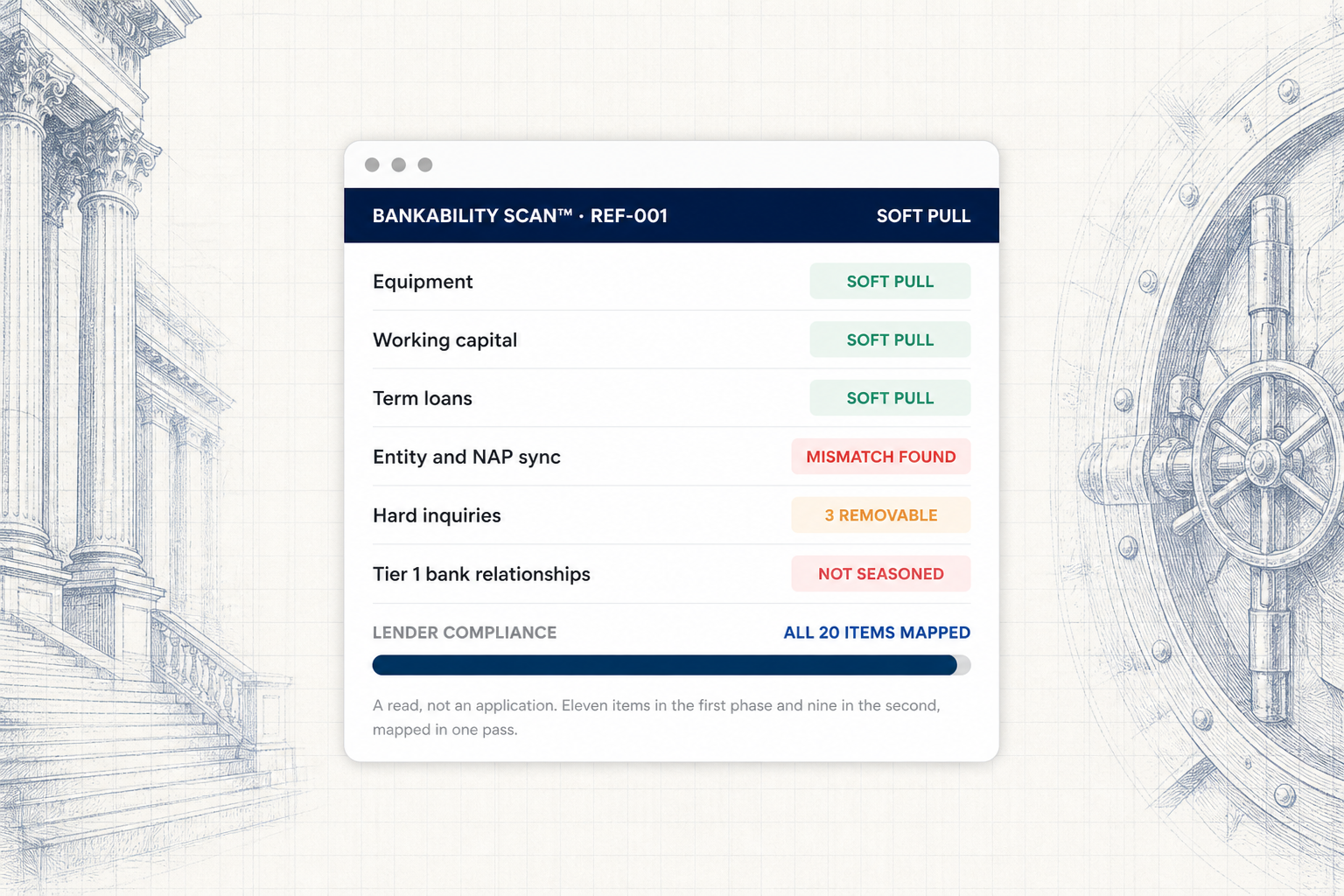
If you want the file read the way a bank reads it, that is what the Bankable Scan™ does.
24. Compliance
This article is educational. It describes public economic releases, lender product pages and general planning methods. It is not credit, legal, tax, or financial advice, not a lending offer, not a forecast of interest rates and not a promise of approval or of any result. Results vary by file. Stacking Capital runs a 1:1 business credit and bank-readiness coaching program. We are not a bank, a lender, or a broker.
Terms change. Rates, offers and product terms cited here are current as of November 25, 2026 and can change without notice. Economic figures are as released by their agencies on that date and can be revised. Dollar examples, Prime paths and owner scenarios are illustrations built on made-up inputs, not quotes or projections.
Approval is not guaranteed. Typical bank small-business cards from the five Tier 1 issuers still collect owner identity details and a personal guarantee. Confirm the current terms on each issuer's page before you apply.
Sources: BEA, Personal Income and Outlays, October 2026; BEA, GDP second estimate, third quarter 2026; BEA, PCE price index; BEA, core PCE price index; BEA, Personal Income and Outlays, September 2026; U.S. Department of Labor, unemployment insurance claims; Census Bureau, advance retail sales; BLS, December 2026 release schedule; Federal Reserve, October 28 FOMC statement; Federal Reserve, H.15 selected interest rates; Federal Reserve, FOMC calendars; Federal Reserve, November 2026 calendar; Federal Reserve Financial Services, dates to remember; CME Group, FedWatch commentary; CNBC, Waller interview; Yahoo Finance, Williams remarks; FXStreet, PCE preview; Admiral Markets, December Fed preview; Wells Fargo, business lines of credit; U.S. Bank, Cash Flow Manager; Chase, business line of credit; Bank of America, unsecured line of credit; Chase, Ink Business Unlimited; Bank of America, Business Advantage Travel Rewards; SBA, 7(a) terms and eligibility; SBA, maximum fixed rates; SBA Procedural Notice 5000-875701; Bankrate, business loan requirements.
Schedule your Bankable Blueprint Call
Bring your balances, your window dates and your rate sheet. We map what floats and what does not before the Fed meets.
The Bankable Scan™ reads the personal and business file the way a bank does. The Bankable Blueprint™ writes the order: compliance items, bureau capacity, the 0% doors that fit the file now, and the exit plan before the window closes. 0% is the start. Bankable is the process.
Book a Bankable Blueprint Call