The take
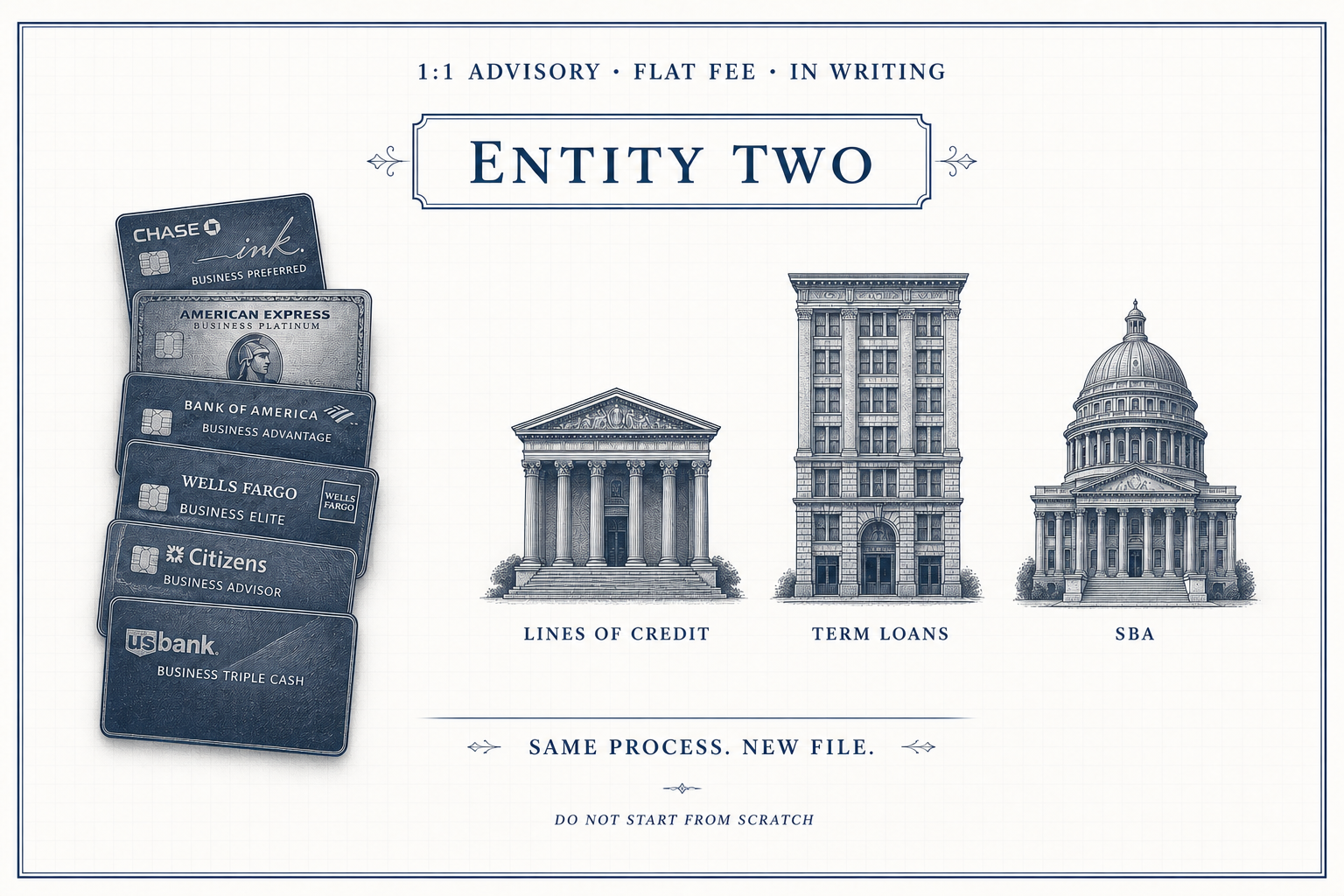
Tier 1 is a short list with a reason behind it. The Bankable Blueprint uses five issuers: Chase, American Express, U.S. Bank, Bank of America and Wells Fargo. Each one offers a 0% business card at the front door and a business line or loan behind it. The list is five because every name has to pass the same tests, and a sixth name adds a credit pull without adding a bank.
- ✓The method. Tier 1 is our label, not a bank rule. A name makes the list only if it passes five tests we explain below. The tests are about what the owner can check and plan, not about who has the biggest ad budget.
- ✓The dollars. A $50,000 draw on a Wells Fargo BusinessLine costs about $364.58 a month at the low end of its published range and about $697.92 at the high end, with Prime at 7.00%. Knowing which end you land on is why the card round comes first and the line comes later.
- ✓The timing. The cards open in Month 3. The published bars for the lines range from six months in business at Wells Fargo to two years at Bank of America and Chase. So the card rounds build the record while the line bars catch up.
- ✓Same file. Same banks. Different order. The Bankable Blueprint™ does not use different banks than anyone else. It uses the same five in a planned order. And at each of them, a typical small-business card still carries a personal guarantee. An EIN or LLC does not remove it.
2. Five tests for Tier 1
Owners ask a fair question: why these five? Why not ten? Why not whoever pays the best sign-up bonus this month?
The honest answer is that Tier 1 is a method choice. We list an issuer only if it passes all five tests below. Each test is about something you can verify on the issuer's own pages.
- A 0% card at the front door. The issuer sells a business card with a 0% introductory window on purchases.
- A bank line or loan behind it. The same institution lends on a business line or loan, so a card file can grow into a bank file.
- Terms you can check. The issuer publishes the numbers that matter on its own pages: fees, rates, limits and bars.
- The same underwriting shape. The issuer reads a personal and business file together and asks for an owner's guarantee on typical products.
- A place in the order. The issuer fits a same-day round without breaking the rounds around it.
Fail one test and the name stays off the list. That does not make it a bad lender. It means the Blueprint plans around it differently, or not at all.
3. Test one: a 0% card at the front door
The first test is the easiest to check. Every Tier 1 issuer sells a no-annual-fee business card with a 0% purchase window. That window is why the Blueprint starts with cards: it gives the owner working capital without interest for a planned stretch, if the balance is paid by the date the window ends.
| Issuer | Example card | 0% window on purchases | Annual fee |
|---|---|---|---|
| Chase | Ink Business Unlimited and Ink Business Cash | 12 months from account opening | $0 |
| American Express | Blue Business Plus | 12 months from account opening, per NerdWallet | $0 |
| U.S. Bank | Triple Cash Rewards Visa Business | 12 billing cycles on purchases and balance transfers made within 30 days | $0 |
| Bank of America | Business Advantage Unlimited Cash Rewards | Billing-cycle window set in your offer; third-party reviews list 7 billing cycles | $0 |
| Wells Fargo | Signify Business Cash | 12 months from account opening | $0 |
Read the window column as a calendar, not as a benefit. Four of the five run about a year. Bank of America's runs shorter. If you open all five on the same day in Round 1, the Bank of America window is the first to close, and that is the first payoff date on your plan.
Remember what 0% means. It means 0% interest on the balance during the window. It does not mean zero monthly payment. A made-up $20,000 balance with a 1% to 1.5% monthly payment is $200 to $300 a month, and clearing it in 12 months takes $1,666.67 a month. Our exit plan guide shows how to plan it.
4. Test two: a bank line behind it
The second test is the one that separates a card list from a Blueprint. Each Tier 1 issuer also lends. So a card round does not end the story. It starts a banking relationship that can lead to a line.
| Issuer | Product | Published size | Published bars |
|---|---|---|---|
| Chase | Business Line of Credit | $10,000 to $500,000, variable, indexed to Prime | $100,000 of annual revenue, FICO of at least 660, ownership and management unchanged for two years |
| American Express | Business Line of Credit | $2,000 to $250,000 on qualification, with increases possible later. A monthly loan fee of 0.55% to 1.55% replaces an interest rate | One year in business, FICO of at least 660, average monthly revenue of at least $3,000 |
| U.S. Bank | Cash Flow Manager | Secured up to $250,000, unsecured up to $100,000, variable | Annual fee $0 over $50,000 and $150 at $50,000 or less |
| Bank of America | Business Advantage Credit Line | $10,000 to $250,000, unsecured, revolving | Two years in business, $100,000 of prior-year revenue, and typically a personal FICO above 700 |
| Wells Fargo | BusinessLine | $10,000 to $150,000, Prime plus 1.75% to Prime plus 9.75% | Six months in business, guarantors typically at a FICO of 680 or higher |
Each of these has its own full guide on this site: Chase, American Express, U.S. Bank, Bank of America and Wells Fargo. Read the one for the bank you already use.
What the numbers cost
Take Wells Fargo as the example because it publishes a spread range. With Prime at 7.00%, the low end is 8.75% and the high end is 16.75%. A made-up $50,000 draw costs about $364.58 a month at the low end and $697.92 at the high end. The gap is $333.34 a month, or about $4,000 a year, and it depends on how the bank reads your personal and business file. That is why the Blueprint works on the file before it asks for the line.
Chase shows a different cost. Its business line charges an annual fee of $200 or 0.25% of the approved line, whichever is greater, up to $750, waived after the first year if your 12-month average use is at least 40% of the line. On a made-up $100,000 line that is $250. At $300,000 and up it hits the $750 cap. So a bigger line is not free to hold if you do not use it.
American Express prices differently again. It charges a monthly loan fee instead of a Prime-based rate, and the fee is disclosed before you accept. If you compare Amex with a Prime line, convert both to a yearly dollar cost on the same balance and term.
5. What the bars say about timing
Line the bars up and a pattern appears. Cards open in Month 3. Lines open later, and each one has its own gate.
| Issuer | Time in business | Revenue bar | What it means for planning |
|---|---|---|---|
| Wells Fargo | Six months or more | Confirm with Wells Fargo | The earliest published time bar of the five |
| American Express | One year | $3,000 a month average | About $36,000 a year of revenue is the entry mark |
| Chase | No minimum stated. Ownership and management unchanged for two years | $100,000 a year | A change in majority owners resets the clock |
| Bank of America | Two years | $100,000 prior year | The longest wait of the five |
| U.S. Bank | Confirm with U.S. Bank | Confirm with U.S. Bank | Ask a banker before you plan |
So what does the order look like? A business in its first year can run the card rounds, build a record, and wait for the line bars to clear. A business at two years with $100,000 of revenue can reach every line on the list. The Blueprint's rounds are designed to make that wait productive. The first year is not empty. It builds ten to fifteen trade lines and a clean payment history. That is Leg 3, and our trade line guide explains the count.
Note the Chase wording. Instead of a minimum time in business, Chase asks that majority ownership and management have stayed the same for two years. If you bought into a company last spring, that matters more than the date on your articles of organization.
6. Test three: terms you can check
Every number in sections 3 and 4 comes from a page you can open yourself. That is test three, and it is stricter than it sounds.
Many lenders hide the numbers that matter. They advertise a speed or an amount and leave the price for a call. They may show a factor rate, a daily payment or a fee schedule that is hard to turn into a yearly cost. Such products can still be legal. They are hard to plan around, which is the point of the test.
The Tier 1 issuers publish enough to run a plan. You can see the fee on each card. You can see the window length. You can see the line size and the bar. Where a page shows placeholders or leaves a number out, that is a signal to ask the bank in writing before you build a plan on it. For instance, Bank of America's card page shows blank intro values in places, so the 7 billing cycles you may see in third-party reviews is something to confirm in your own offer.
A one-page checkable-terms sheet
Make a sheet with five rows, one per issuer. For each, write the card window, the card fee, the line size, the line bar and the page you got it from. Add the date you read it. Terms change, and a sheet with dates is worth more than a memory.
It takes about an hour. It replaces a month of guessing.
7. Test four: the same personal guarantee
The fourth test is about shape. All five issuers read a personal file and a business file together on typical small-business products, and they ask the owner to stand behind the debt.
The page evidence is plain on the lines. Chase says anyone with 20% or more ownership must personally guarantee the debt. Wells Fargo requires guarantees from owners of 25% or more, with a minimum combined aggregate of 51% ownership. U.S. Bank's page requires one for small business loans and lines. Our own guides on each line cover the same point.
On the cards, the same shape holds. Chase's own education page says a personal guarantee is a common requirement on business cards, and that issuers typically run a hard inquiry on your personal report when you apply for a business card with personal liability. So typical bank small-business cards at Chase, Amex, U.S. Bank, Bank of America and Wells Fargo still collect owner identity details and a personal guarantee. An EIN or LLC does not remove it. Some corporate or spend-management cards skip a guarantee when the issuer underwrites the company. If someone offers you one, confirm on the issuer's page.
What does this mean in dollars? If you take a $150,000 line and the business cannot pay, the lender can ask you to pay it. So the owner's file is part of the product. That is why Leg 1, lender compliance, comes first. Our compliance guide lists what banks check before they look at numbers.
Reporting is not the same thing
A guarantee does not tell you what an issuer reports. Chase's education page says business cards with personal liability may share account information with credit bureaus, and that whether they do depends on the issuer and the card. Check each issuer's current practice. Our guide on which cards pull and report to business bureaus keeps the details, and your own personal reports will show what posts.
8. Why five, and not more
If five is good, would ten be better? Not for this method, for three reasons.
Reason one: each name adds a pull
A new issuer usually means a new credit check on your personal report. Chase's education page says applying for a business card with personal liability typically brings a hard inquiry. Five issuers on the same day is a controlled cluster. Ten issuers is a larger one, with less to show for it. Our Round 1 hard pull map shows how the pulls fall by issuer.
Reason two: a name without a bank behind it adds no path
A sixth issuer that sells cards but has no line or loan behind them gives you a card and nothing to grow into. It adds a pull and a payment date. It does not add a Month 12 option. That is test two.
Reason three: the rounds need room
Round 1 is Month 3, with all five on the same day. Round 2 is Months 7 to 8, with four issuers, skipping Wells Fargo. Round 3 is Months 11 to 12, with all five again. That is three rounds with a plan for each. Every extra name adds a payoff date and a monthly payment to each round. A calendar with fifteen windows closing is harder to run than one with five. See why Round 2 skips Wells Fargo for the Round 2 logic.
The cost of a crowded calendar is not abstract. A made-up owner with 15 cards, each carrying $4,000, has $60,000 of balances and a 1% to 1.5% monthly payment of $600 to $900. Miss one payoff date and that card's balance starts costing 16.99% to 24.99% in interest, which on $4,000 is $56.63 to $83.30 a month. One missed date is a nuisance. Five missed dates is a budget problem.
9. What each issuer does in the rounds
Each Tier 1 name plays a role. This table is the planning view. It is our method, not an issuer rule.
| Issuer | Round 1 (Month 3) | Round 2 (Months 7 to 8) | Round 3 (Months 11 to 12) | Line, later |
|---|---|---|---|---|
| American Express | Opens first on the day, where an existing relationship supports a soft-pull path | Included | Included | Business Line of Credit |
| Chase | Included | Included | Included | Business Line of Credit |
| U.S. Bank | Included | Included | Included | Cash Flow Manager |
| Bank of America | Included | Included | Included | Business Advantage Credit Line |
| Wells Fargo | Included | Skipped | Included | BusinessLine |
The soft-pull path at Amex depends on an existing Amex relationship. Do not assume it applies to you. The hard pull map explains how to check. And the order inside a round matters, because each approval can change what the next issuer sees.
The line column is a planning default, not a Blueprint round. Lines are separate applications with their own timing. We usually place a bank line after Round 3, on a day of its own, so the card activity has time to season. That is a method choice, not a bank rule.
- Months 0 to 3 Clear Leg 1 items. Match names, addresses and numbers across documents. Pull your personal reports.
- Month 3 Round 1. All five issuers the same day, Amex first where a soft-pull path exists.
- Months 4 to 6 Season the accounts. Pay on time. Track every window end date.
- Months 7 to 8 Round 2. Four issuers, skipping Wells Fargo.
- Months 11 to 12 Round 3. All five again.
- After Round 3 Check each line's bars. Apply for a line on its own day when the file meets them.
10. After Tier 1
Tier 1 is the first layer, not the last. Once the five are in place and the file has seasoned, other lenders become reachable: regional banks, credit unions and SBA lenders.
Those lenders read files a little differently. Some lean on a different business or personal credit bureau than the one the cards used. Our guide on credit unions and the Equifax round explains one example. SBA loans have their own bars. See how SBA small-loan underwriting works now and the term-out playbook for moving card balances into longer debt.
Why not start there? Because the card round builds the record that makes the next layer easier. A file that has paid five issuers on time for a year reads differently from a file with no history. The Blueprint orders the doors. It does not skip any.
11. When a product changes hands
Tier 1 is about the issuer, not about one card. Cards move between issuers, and the planning follows the issuer.
A recent example is the Amazon business card. Our issuer change guide covers how it moved from Amex to U.S. Bank on August 14, 2026 and what that did to a Round 1 plan. The lesson is general. Before you apply, confirm who the issuer is today. A co-brand name on the card does not tell you.
The same goes for terms. Sign-up bonuses, windows and fees change often, and the line bars change less often. So plan on the bars and the order, and treat the bonus as a bonus.
12. Six mistakes
- Adding a sixth name because of a bonus. A bonus is not a path. Ask what the issuer does for the file in Month 12.
- Treating Tier 1 as a bank rule. It is our planning list. Issuers do not use the term.
- Planning on a number from an ad. Use the page that shows the fee, the window and the bar.
- Assuming an EIN removes the guarantee. On typical cards and lines, it does not.
- Applying for a line before the bars clear. Check time in business, revenue and ownership first.
- Forgetting the window calendar. Five issuers mean five end dates. Write them down on day one.
13. Questions owners ask
What does Tier 1 mean in the Bankable Blueprint?
It is our list of five issuers: Chase, American Express, U.S. Bank, Bank of America and Wells Fargo. Each sells a no-fee 0% business card and lends on a business line or loan. It is a planning label, not a bank rule.
Why are there only five Tier 1 issuers?
Each name adds a credit check and a payoff date. A name without a bank line behind it adds no path to Month 12. So the list stays at five.
Do all Tier 1 issuers require a personal guarantee?
Typical bank small-business cards and lines at these five still collect owner identity details and a personal guarantee. An EIN or LLC does not remove it. Some corporate cards skip a guarantee when the issuer underwrites the company, so confirm on the issuer's page.
Which Tier 1 line has the lowest published bar?
Wells Fargo's BusinessLine page shows six months in business, which is the shortest published bar among the five. Bank of America's unsecured line asks for two years. Confirm current bars on each page.
Does a 0% card report to my personal credit?
It depends on the issuer and the card. Chase says business cards with personal liability may share account information with credit bureaus. Check your personal reports and ask the issuer.
Can I skip the cards and go straight to a line?
You can apply. Whether you qualify depends on the bars and your file. The Blueprint orders the cards first because the card rounds build a payment record and a banking relationship before the line application.
14. Open items
- Tier 1 is our label. Issuers do not use it, and it does not mean other lenders are poor choices.
- Card windows. Bank of America's window is set in your offer. Third-party reviews list 7 billing cycles. Confirm yours.
- Line bars. Revenue, time-in-business and credit bars come from each page as of November 28, 2026. Banks can also apply other factors.
- U.S. Bank's line. Size and fees are as shown on its page. Ask a banker for the current time and revenue bars.
- Amex soft-pull path. It depends on an existing relationship. Do not assume it applies to you.
- Reporting. Whether a card appears on a personal or business bureau varies and can change. Check your reports.
- All dollar examples. Balances, draws and card counts are made up for illustration. They are not quotes or projections.
15. What to do next
- This week Build the one-page sheet: five issuers, card window, card fee, line size, line bar, source page and the date you read it.
- This week Check your own file against the bars: time in business, revenue, ownership changes and your personal score.
- Before Round 1 Clear Leg 1 items and pull your personal reports. Run the pre-application checklist.
- Round 1 Open on the same day. Write every window end date on one calendar.
- After Round 3 Re-read the line bars and choose a line on a day of its own.
If you want the file read the way a bank reads it, that is what the Bankable Scan™ does.
16. Compliance
This article is educational. It describes public product pages and general planning methods. It is not credit, legal, tax, or financial advice, not a lending offer and not a promise of approval or of any result. Results vary by file. Stacking Capital runs a 1:1 business credit and bank-readiness coaching program. We are not a bank, a lender, or a broker.
Terms change. Fees, rates, offers and bars cited here are current as of November 28, 2026 and can change without notice. Dollar examples and owner scenarios are made-up illustrations, not quotes or projections.
Approval is not guaranteed. Typical bank small-business cards from the five Tier 1 issuers still collect owner identity details and a personal guarantee. Confirm the current terms on each issuer's page before you apply.
Sources: Chase, Ink Business Unlimited; Chase, Ink Business Cash; Chase, business line of credit; Chase, how business credit cards may affect your personal credit score; American Express, Business Line of Credit; U.S. Bank, Triple Cash Rewards Visa Business Card; U.S. Bank, Cash Flow Manager; Bank of America, Business Advantage Unlimited Cash Rewards; Bank of America, unsecured line of credit; Wells Fargo, Signify Business Cash; Wells Fargo, BusinessLine; NerdWallet, Amex Blue Business Plus review; Federal Reserve, H.15 selected interest rates.
Schedule your Bankable Blueprint Call
Bring your file and your questions. We map which of the five fit now, in what order, and when each line's bar clears.
The Bankable Scan™ reads the personal and business file the way a bank does. The Bankable Blueprint™ writes the order: compliance items, bureau capacity, the 0% doors that fit the file now, and the exit plan before the window closes. 0% is the start. Bankable is the process.
Book a Bankable Blueprint Call