Library · Lending intelligence
Credit stacking is a tactic. Bankable is the outcome.
A sequenced 0% round is where most files start. Layering cheap capital before expensive capital is sound on its own terms; what it cannot do is make an underwriter read the file differently.
What is credit stacking?
Credit stacking is the practice of obtaining multiple business credit cards or lines of credit in a coordinated sequence, typically targeting 0% introductory APR offers, to access substantial working capital without immediate interest costs.
The strategy works because business credit cards from tier 1 banks (Chase, American Express, Bank of America, Wells Fargo, U.S. Bank) typically do not report ongoing balances to personal credit bureaus. This means you can carry high utilization on business cards without affecting your personal credit score.
But the sequence matters. Each bank reads a different credit bureau, tolerates a different number of inquiries, and weighs existing limits differently. Apply in the wrong order and you burn approvals. Apply in the right order and the file gets stronger with each round.
The 13-tier cost-of-capital ladder
Always start at the top. Never skip rungs.
What decides which rung you can actually reach is the file. We build the profile that makes the top of this ladder available, and the same profile is what a bank later reads for a line of credit, a term loan or SBA. Nothing on this list is a rate we set or an offer we make.
The 5 tier 1 banks
Every credit stack is built on these institutions. Each one reads different bureaus and tolerates different inquiry patterns.
Chase
American Express
Bank of America
Wells Fargo
U.S. Bank
Why sequence matters
The order you apply matters more than the cards themselves. Here's why:
- Bureau sensitivity: Chase primarily pulls Experian. Amex primarily pulls Experian. Apply to both on the same day and the second bank sees the first inquiry. Apply in the wrong order and inquiry-sensitive banks auto-decline.
- Inquiry tolerance: Wells Fargo has a 1/6 rule (one card per 6 months). U.S. Bank has an informal 5/12 rule. Chase has 5/24 for personal cards but business cards are exempt. Sequence determines how many approvals you get before hitting velocity limits.
- Comparable limits: The second bank reads your first approval as a comparable-limit signal. A $25K Chase approval makes a $25K Amex approval more likely. But only if Chase goes first.
That's why we sequence applications live on Zoom. Same file, same banks, different order = different outcome.
7 credit stacking mistakes that kill approvals
Applying before the file is ready
Fix: Run the file scan first. Fix compliance items before applications go out.
Ignoring bureau sensitivity
Fix: Know which bureau each bank pulls and space applications accordingly.
Maxing out too early
Fix: Utilization has no memory, but comparable limits matter. Don't burn your best approval on a $5K card.
No exit plan
Fix: Build the 0% exit plan before round one. The promo ending is not a surprise.
Applying to inquiry-sensitive banks last
Fix: Wells Fargo and U.S. Bank care about inquiry count. Sequence them early or skip them in round one.
Not seasoning between rounds
Fix: Let new limits season 90-180 days. Remove inquiries that never became accounts.
Ignoring business credit
Fix: PAYDEX and Intelliscore unlock the institutional side. Build them in parallel while card rounds run.
How Stacking Capital does it differently
Most funding companies apply to every bank in whatever order feels right, collect a 10-20% success fee, and disappear. We built the opposite model.
Before a single application goes out, three things run. A soft pull pre-qual reads twenty funding programs covering equipment, working capital and term loans. The file scan covers 47+ data points across the personal and business profile. And lender compliance clears the twenty items on it. We fix every blocker a bank’s algorithm will find, before the bank sees it.
Then we sequence applications by bureau sensitivity and inquiry tolerance. Every application happens live on Zoom with your advisor. Between rounds we remove inquiries that never became accounts and let the new limits season.
The fee is a flat one-time fee for six months. The more capital you access, the cheaper every dollar gets. We went the opposite direction on purpose.
Read the file first.
Then the plan.
On the call we read your file as a bank reads it, and set out what has to be cleared before it is bankable. A sequenced 0% round is where most files start.
Book a Bankable Blueprint Call →$100K minimum guarantee, in writing.
0% is the start. Then the same banks.
Credit stacking is a tactic. Bankable is the outcome. The first round is 0%. The same file then reaches lines of credit, term loans, and SBA. One advisor. A written plan. The next round designed before the first one closes.
- 01 · 0%, the start
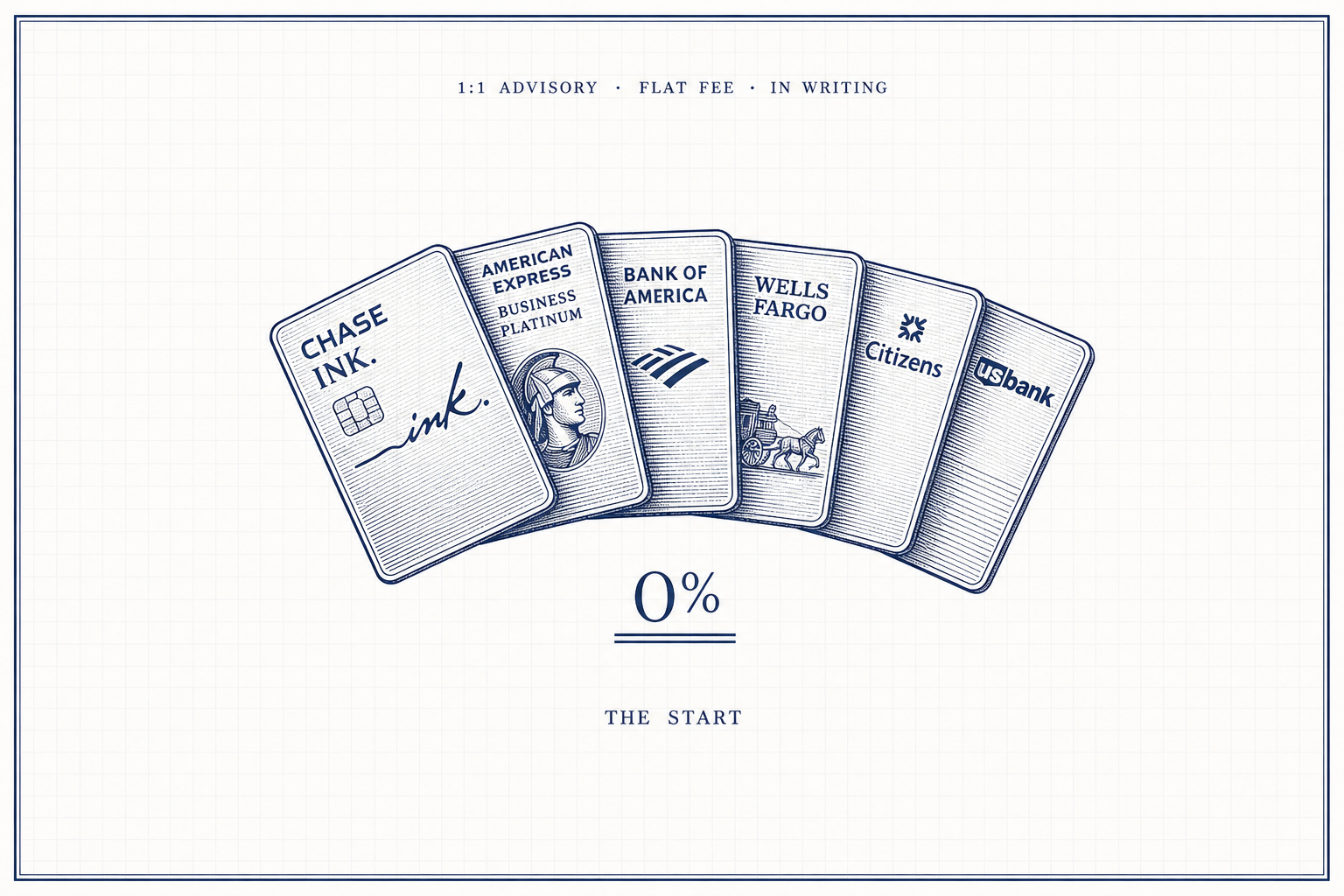
Roughly twelve months of runway at 0% interest, across six issuers, in the order the banks reward. This is the cheapest capital these programs offer and it is where nearly every file starts. Layering it is the tactic. It is not the outcome.
- 02 · Lines of credit

Revolving capital from a traditional bank, sized against the file rather than against a card limit. Nothing about it expires with a promotional period. Added to the 0%.
- 03 · Term loans
Fixed capital over a set term, priced on the entity: time in business, the reported history, the cash flow behind it. Installment history a revolving round cannot build on its own.
- 04 · SBA
The longest money on the file. A bank loan with a federal guarantee behind it, underwritten on the strength of the entity, which is what the first round and the compliance work were quietly preparing for.
We are not a shop that stops at cards. Approvals, limits and terms are decided by the institutions and depend on the file. Program ceilings belong to the programs, so nothing here is a promised amount, rate or date.
The Bankable Blueprint™ · 1:1 capital advisory for established business owners
Book a Bankable Blueprint Call