The take
When a 0% window ends, you owe a decision on the card itself, not only on the balance. Most no-fee cards should stay open. Fee cards should earn their fee or change product. Closing is the last move, and it should come after you redeem rewards.
- ✓Three moves. Keep the card, change it to a different card from the same issuer, or close it. Each has a dollar cost. Pick on purpose, with the numbers on one page.
- ✓The fee test. Chase lists a $95 annual fee on Ink Business Preferred. If the card earns 1.5 cents more per dollar than a no-fee card, you need about $6,333 of yearly spend in its bonus categories just to break even. A made-up number, but the method is yours to copy.
- ✓The rewards trap. Chase says you lose unused points if you close the account and have no other open Chase card to hold them. Redeem or move points first.
- ✓Same file. Same banks. Different order. The Bankable Blueprint™ opens cards in three rounds and plans the exit for each. The card decision belongs on that same calendar. Typical bank small-business cards at the five Tier 1 issuers still carry a personal guarantee, and closing a card does not erase a balance you owe.
2. Three moves, not one
You did the hard part. You used a 0% window, you paid the balance, and the clock stopped. Now the card sits in your wallet with a limit, a rate and sometimes a fee. What do you do with it?
Most owners do nothing. A few cancel in a rush. Both can cost money. This guide gives you a plain way to decide. It follows the 0% exit plan, which covers how to clear the balance. Here we cover what comes after.
You have three moves.
- Keep it. Leave the account open. Use it a little, pay it in full, and let the limit sit.
- Change it. Ask the issuer to switch the account to another card it offers. Same account, new terms.
- Close it. End the account. Do this only after the balance is zero and the rewards are redeemed.
Here is how those moves compare for a made-up owner with one card that has a $0 fee and a 16.99% ongoing rate.
| Move | Yearly cost in fees | Cost if you carry nothing | What you give up |
|---|---|---|---|
| Keep | $0 | $0 in interest | Nothing, if you pay in full |
| Change | Depends on the new card | $0 in interest | New-card bonus and 0% offers |
| Close | $0 | $0 in interest | The open limit and any unredeemed rewards |
Look at the first row. A no-fee card with a zero balance costs nothing to keep. So the burden of proof sits on the move that gives something up. That is the rule this whole guide follows: do not give anything up unless the math says you gain.
3. What each card costs after the window
Start with facts, not feelings. The table below shows what each issuer's own page says about the fee, the 0% window, the rate afterward and what happens to rewards. Pull your own card agreement next to it, because your offer may differ.
| Card | Annual fee | 0% window | Rate after | Reward rule to know |
|---|---|---|---|---|
| Chase Ink Business Unlimited | $0 | 12 months on purchases | 16.99% to 24.99% variable | Points do not expire while the account is open, per Chase |
| Chase Ink Business Preferred | $95 | None shown on the offer page | 17.99% to 28.74% variable | Same Chase points rule |
| Amex Blue Business Plus | $0 | 12 months on purchases | 16.99% to 28.74% variable, per NerdWallet | Points tied to a Membership Rewards account |
| Amex Business Gold and Platinum | $375 and $895 | Not an intro card | Check the offer | Same Membership Rewards rule |
| U.S. Bank Triple Cash Rewards | $0 | 12 billing cycles on purchases and balance transfers | Check the offer | Cash rewards expire after 12 straight statement cycles with no activity, per U.S. Bank |
| Bank of America Business Advantage Unlimited Cash | $0 | Confirm in your offer | Confirm in your offer | Rewards do not expire while the account is open, per Bank of America |
| Wells Fargo Signify Business Cash | $0 | 12 months on purchases | 16.99% to 24.99% variable | Rewards do not expire while the account is open, per Wells Fargo |
Fee and rate figures come from the Amex card comparison page and the issuer pages linked above, as of November 26, 2026. Bank of America's page shows blank placeholders for its intro terms, so read your own offer.
Three things stand out. First, most of these cards cost $0 a year. Second, the ongoing rates run from the high teens to the high twenties. Third, every issuer ties rewards to an open account in some way. That third point matters most when you think about closing.
One more reminder from the Blueprint. The five Tier 1 issuers do not report ongoing business card balances to personal bureaus. That is why a business card at zero changes little on your personal file. It is also why you should confirm the details for your own card before you rely on it. Our guide on which cards pull and report to business bureaus keeps the current list.
4. Keeping a card open
For a no-fee card at zero, keeping is the default. NerdWallet says it is generally advisable to keep a card open once the intro period ends, especially after you have paid off the balance. It adds that you can use the card sparingly to keep the account active.
Why does that matter for a business? Three reasons.
- The limit is a tool. An open limit can cover a slow month, a supplier deposit or a gap before a customer pays. You pay nothing for it until you use it.
- The rewards stay alive. Chase, Bank of America and Wells Fargo all say rewards do not expire while the account is open. Closing ends that.
- The history stays. A long-open account is a longer record of paying on time. Whether it shows on your personal file depends on the issuer's reporting, so check your reports.
The cost of keeping is discipline. A card at zero is safe. A card you carry at 16.99% to 24.99% is not. So set rules before the window ends.
Keep it alive without spending much
Issuers can close accounts that sit unused. They do not owe you a warning. U.S. Bank adds a second wrinkle: its cash rewards expire if the account has no reward, purchase or balance activity for 12 consecutive statement cycles.
The fix is boring. Put one small, steady bill on each card you plan to keep. A $12 software subscription is $144 a year. Pay the card in full every month. Set autopay for the full statement balance, not the minimum. Then the card stays active and costs you nothing in interest. Ask each issuer what counts as activity, because the rules differ.
If you already built the monthly payment system for your stack, add one line to it for each kept card: the bill that lives there and the date it posts.
5. Changing the product
A product change moves your existing account to a different card from the same issuer. You do not apply again. Chase's own guide says an issuer's review for a switch typically does not involve a hard credit check. It also says that if the issuer lets you switch without closing, you could keep the age of your account, because the account stays the same.
Chase lists the tradeoffs too. You may lose rewards depending on the issuer's policy, benefits can change, and the rate and fees may change. Chase also notes that some issuers want the account to be a certain age before you can switch.
Bank of America's page shows a "Change card" section that lists three Business Advantage cards, Unlimited Cash Rewards, Customized Cash Rewards and Travel Rewards. That tells you the option exists inside that family. Whether you qualify is for the bank to say. Ask Amex and U.S. Bank what options exist for your card.
What do you give up? Nav notes that you will not get a sign-up bonus or promotional financing on the new card, since you did not apply for it. For a card whose 0% window already ended, that costs you nothing. The offers were used up anyway.
When a change beats closing
Use a change when the card carries a fee you do not earn back but you still want the account. A fee card changed to a no-fee card keeps the history and the limit and drops the cost. Compare that with closing: closing drops the cost too, but it also drops the limit and puts your rewards at risk.
A change also helps if the issuer's no-fee card pays about what the fee card paid. Run the break-even in the next section before you call.
6. Closing, and what it really costs
Sometimes closing is right. A card with a big fee you do not earn back, with no change option, is a fair candidate. A card you keep misusing is another. Before you do it, check four costs.
Cost one: lost rewards
Each issuer treats rewards differently when an account closes.
| Issuer | What the issuer says | What to do first |
|---|---|---|
| Chase | Points do not expire while the account is open. You can lose them if the account closes, unless another open Chase card holds them. Other closure reasons may give at least 30 days, per Chase's program agreement | Redeem or move points to another Chase card |
| American Express | If you cancel the last product linked to your Rewards Account, you lose all points. If another product stays linked, the points stay, per Amex's Membership Rewards terms | Redeem before canceling a last linked card |
| U.S. Bank | The page does not say what happens at closing. It says the account must be open and in good standing to earn and redeem | Redeem cash rewards, then ask |
| Bank of America | Rewards do not expire while the account is open | Redeem before closing |
| Wells Fargo | Rewards do not expire while the account is open. The page is silent on closing | Redeem before closing |
The pattern is clear. Redeem first. Close second. One phone call and a few minutes can protect hundreds of dollars on a busy card.
Cost two: the open limit
A closed card takes its limit with it. For a business with a low or uneven cash cushion, that is real. Section 8 puts dollars on it.
Cost three: your personal file, maybe
Here the facts depend on the card. Nav explains that closing a business card affects your personal score only if the issuer reports the card to personal bureaus or the lost limit changes personal utilization. It also says a card that does not appear on your personal reports will not affect your personal credit through that reporting.
That fits the Blueprint's signature point. The five Tier 1 issuers do not report ongoing business card balances to personal bureaus. So closing one of their business cards in good standing should move your personal utilization very little. Pull your own reports to confirm. And if a card ever goes seriously late, that can change.
Cost four: your promise to pay
Closing a card does not erase what you owe. It also does not remove the personal guarantee you signed. If a balance remains at closing, you still owe it, with interest. So pay it to zero first. The exit plan tells you how.
The right way to close, in order
- Pay the balance to zero and wait for the last charge to post.
- Redeem or move rewards.
- Move every recurring bill and autopay to another card.
- Ask about a product change or a fee waiver before you say "close."
- Close in writing, or get a confirmation number, and keep it.
- Check the next statement for a zero balance and a closed account.
7. The annual fee math
A fee card has to earn its fee. The test is simple. Take the fee. Divide it by how many extra cents the card earns per dollar compared with a no-fee card you could use instead. The answer is the yearly spend you need just to break even.
Take Ink Business Preferred. Chase's offer page shows 3x points on travel and business categories up to $150,000 combined spend, with a $95 fee. Ink Business Unlimited earns 1.5% back with a $0 fee. Here is a made-up version where one point is worth one cent. The real value of points depends on how you redeem them.
| Yearly bonus-category spend | Extra rewards (1.5 cents per dollar) | Annual fee | Net gain or loss |
|---|---|---|---|
| $3,000 | $45 | $95 | Lose $50 |
| $6,333 | $95 | $95 | Break even |
| $20,000 | $300 | $95 | Gain $205 |
The $6,333 comes from $95 divided by 0.015. If your bonus-category spend is $3,000, the fee card loses $50 a year. If it is $20,000, it wins by $205. So the right answer depends on your books, not on the card's reputation.
Now try a bigger fee. Suppose a card charges $375 and earns one extra cent per dollar in the places you spend. Break even is $375 divided by 0.01, or $37,500 a year. Many small businesses do not spend that much in one category. Ask your bookkeeper for last year's total by category, then check.
8. Unused limit: tool or trap
A limit you do not use is a promise of cash. It costs nothing until you draw. The danger is that it is easy to draw, and the ongoing rate is high.
Take a made-up $20,000 draw on a Chase Ink Unlimited card after the window ends. Chase shows an ongoing rate of 16.99% to 24.99% variable on its page. Here is what $20,000 costs for one month in interest alone.
| Rate | Interest for one month | Interest for 12 months if you do not pay down |
|---|---|---|
| 16.99% | $283.17 | $3,398 |
| 24.99% | $416.50 | $4,998 |
That is the price of using the limit as a loan. It is far above what a bank line would charge. A bank line at Prime plus a few points costs less, and our line of credit guide shows what a bank asks for. So use the card limit for short gaps you will repay in weeks. Do not use it as a permanent loan.
Remember also that 0% does not mean zero monthly payment. While a window is open, you still owe a payment each month, often about 1% to 1.5% of the balance. After the window, interest joins that payment.
Set a rule before you need it
Write one sentence now and tape it to the file. For example: "I use a card only for a gap I can repay in 30 days, and I pay the full statement." If a draw lasts longer than that, move it to a bank line or term loan. The rule costs nothing. Breaking it costs hundreds.
9. A decision calendar by round
The Blueprint opens cards in three rounds. Round 1 is Month 3, with all five Tier 1 issuers the same day. Round 2 is Months 7 to 8 with four issuers, skipping Wells Fargo. Round 3 is Months 11 to 12 with all five. Each round starts its own clock, so you will have decisions coming up in waves.
Here is a made-up owner's calendar. A 12-month window opened in a round ends 12 months later. A Bank of America card with seven billing cycles ends about seven months later. The decision work starts about 90 days before the window ends.
| Round | Opened in program month | 12-month windows end about | 7-cycle Bank of America window ends about | Start decision work about |
|---|---|---|---|---|
| Round 1 | 3 | 15 | 10 | Month 12 (Month 7 for Bank of America) |
| Round 2 | 7 to 8 | 19 to 20 | 14 to 15 | Month 16 to 17 (Month 11 to 12 for Bank of America) |
| Round 3 | 11 to 12 | 23 to 24 | 18 to 19 | Month 20 to 21 (Month 15 to 16 for Bank of America) |
Two things jump out. The Bank of America window from Round 1 ends around Month 10, just before Round 3 opens. The Round 3 decisions come after the whole stack has been built. That gives you a clear order: pay down, decide, then apply again.
If you are between rounds now, our guide on what to do between Round 1 and Round 2 covers the waiting period. The reasons for the Round 2 and Round 3 design are in why Round 2 skips Wells Fargo and why Round 3 exists.
- 90 days before List every card in the window. Write the balance, the window end date and the annual fee date.
- 60 days before Run the fee test. Decide keep, change or close for each card. Call about a change or a fee waiver.
- 30 days before Pay the balance to zero or have a dated plan. Redeem rewards on any card you will close.
- 7 days before Move autopay and recurring bills. Set a small steady charge on each card you keep.
- After the window Check the next statement. Confirm the balance, the rate and any fee. Write the date of your next review.
10. A made-up stack, card by card
Here is how the numbers work together. A made-up owner has seven cards. All balances are zero after the windows ended. The owner went through last year's books to see how much the fee cards earned beyond a no-fee alternative. These numbers are invented for illustration.
| Card | Annual fee | Extra rewards earned | Net | Move |
|---|---|---|---|---|
| Chase Ink Business Unlimited | $0 | $0 | $0 | Keep. Put a small bill on it |
| Chase Ink Business Preferred | $95 | $45 | Lose $50 | Ask Chase about a no-fee Ink card |
| Amex Blue Business Plus | $0 | $0 | $0 | Keep. It holds the Membership Rewards account |
| Amex Business Gold | $375 | $240 | Lose $135 | Ask about options. Redeem points before any cancel |
| U.S. Bank Triple Cash Rewards | $0 | $0 | $0 | Keep. Add a monthly bill to avoid the 12-cycle expiry |
| Bank of America Business Advantage Unlimited Cash | $0 | $0 | $0 | Keep |
| Wells Fargo Signify Business Cash | $0 | $0 | $0 | Keep |
| Total | $470 | $285 | Lose $185 |
Look at the total. The stack costs $470 a year in fees and earns $285 in extra rewards. So the two fee cards, as used, cost this owner $185 a year more than their no-fee alternatives. Five of seven cards need no action beyond a small bill.
What would this owner do? Call Chase and Amex 60 days before the fee dates. Ask what no-fee options exist for the same account. Ask if the fee can be waived this year. If neither works, redeem the points, move autopay and then decide whether to close. If both fee cards change to no-fee cards, the owner saves up to $470 in fees and gives up $285 in extra rewards. That is $185 saved, plus the cards stay open.
One more note. The Amex Blue Business Plus holds the points account in this example. If the owner closes the Gold card, the points stay as long as another Amex product is still linked to the same Rewards Account, per Amex's terms. That one fact is why the order matters.
11. How this fits the next application
The Blueprint's four Legs are lender compliance, business credit scores, ten to fifteen trade lines and financials. Your card decisions touch all four, in small ways.
- Lender compliance. Open and closed accounts show on the debt schedule you give a lender. Keep that schedule current. Our guide to the business debt schedule shows what banks want.
- Business credit scores. Whether a given card reports to a business bureau varies. Check which cards report before you assume anything.
- Trade lines. The Blueprint plans ten to fifteen accounts that report to business bureaus. A card may or may not report. Do not close or keep a card on the belief that it adds or removes a trade line. Check first. See the trade line guide.
- Financials. A bank reads your statements. A card paid in full each month looks like a managed expense. A card carried at 24.99% looks like a problem. See how banks read your numbers.
Should you close cards just before you apply for a bank line or an SBA loan? Usually no. A lender may count your open limits when it looks at your total debt picture, or it may not. Ask the lender how it treats unused limits, and do not guess. Closing a card in the same month as a major application also adds changes to a file that you want stable. Run our pre-application checklist first.
12. Rates and the December Fed meeting
The Fed meets December 8 to 9, and the market expects a quarter-point hike. We covered what that means in our November 25 note. For this topic, two points matter.
First, a card with a zero balance does not feel a rate hike. Interest is charged on balances. So the cost of keeping a no-fee card open stays at $0.
Second, some ongoing rates float. Chase shows the Ink Unlimited ongoing rate as the lesser of Prime plus a spread and 29.99%. If Prime rises by 0.25 point, a $10,000 balance there costs about $2.08 more a month. That is small. It is another reason to pay in full. A balance you carry gets a little more costly each time Prime moves.
So the rate outlook is not a reason to close cards. It is a reason to keep balances at zero and to check which of your cards float.
13. Seven mistakes
- Closing before redeeming. Chase and Amex both say you can lose points. Redeem first.
- Closing the card that holds the points. Another Amex or Chase card may need to stay open so the points have a home.
- Closing with a balance. The balance does not go away. Neither does your guarantee.
- Forgetting autopay. A closed card means a failed payment on the electric bill or the software tool. Move them first.
- Letting a card sit unused. An issuer can close it, and U.S. Bank cash rewards can expire. Add a small steady bill.
- Paying a fee you do not earn back. Run the break-even 60 days before the fee posts.
- Closing a stack in one month. Spreading changes out keeps your file calm. Do one or two at a time, and not in the month of a big application.
14. Questions owners ask
Should I close a business card after the 0% window ends?
Usually not, if it has no annual fee and a zero balance. A card at zero costs nothing to keep. Close only when the fee is not earned back, the card tempts you to overspend, or you have a clear reason. Redeem rewards first.
Does closing a business card hurt my personal credit?
It depends on whether the issuer reports the card to personal bureaus. Nav says a card that does not appear on your personal reports will not affect your personal credit through that reporting. The five Tier 1 issuers do not report ongoing business card balances to personal bureaus. Check your own reports to confirm.
What is a product change?
It is a switch of your existing account to another card from the same issuer, without a new application. Chase says this typically does not involve a hard credit check. You usually do not get a new sign-up bonus.
Will I lose my points if I close a card?
You can. Chase says you lose unused points if you close the account and have no other open Chase card to hold them. Amex's terms say you lose all points if you cancel the last product linked to your Rewards Account. Redeem or move points before you close.
How do I keep a card active without carrying a balance?
Put one small, steady bill on it and pay the full statement each month. U.S. Bank says its cash rewards expire after 12 consecutive statement cycles with no activity. Ask each issuer what counts as activity.
Does closing a card remove my personal guarantee?
No. If a balance is left, you still owe it. Typical bank small-business cards at Chase, Amex, U.S. Bank, Bank of America and Wells Fargo collect owner identity details and a personal guarantee. An EIN or LLC does not remove it. Some corporate or spend-management cards skip a guarantee when the issuer underwrites the company, so confirm on the issuer's page.
Should I use a kept card as my emergency fund?
Only for a gap you can repay fast. At the ongoing rates on card pages, a $20,000 balance costs about $283 to $417 a month in interest. A bank line usually costs less.
15. Open items
- Your own card agreement. Fees, rates, reward rules and product change options differ by card and by offer. Read yours.
- Product change rules. Issuers decide who can switch and to which card. Ask each issuer, and ask whether a change affects rewards, benefits or the fee date.
- Bank of America's intro terms. The issuer's page showed blank placeholders for the intro rate and billing cycles. Confirm the numbers in your own offer.
- Amex terms. The Membership Rewards terms linked in Compliance are dated May 2023. Confirm the current version with Amex before you cancel a card.
- Reporting. Whether a card appears on a personal or business bureau can vary by card and can change. Pull your own reports.
- Point values. The one-cent value used in the fee math is a made-up simplification. Real value depends on how you redeem.
- Owner examples. All balances, spend and rewards in this guide are made up for illustration. They are not quotes or projections.
- Lender treatment. Ask each lender how it counts unused card limits when it looks at your debt.
16. What to do next
- This week List every card, the fee, the fee date, the window end date and the balance. One page.
- Next 30 days For each fee card, divide the fee by the extra cents it earns per dollar. Compare that with last year's category spend.
- 60 days before a fee Call and ask about a no-fee option and a fee waiver. Write down what you hear.
- Before any close Zero the balance, redeem the rewards and move the autopay.
- Every card you keep Attach one small bill and set autopay to pay in full.
- Before any application Run the pre-application checklist, and leave a quiet month before it.
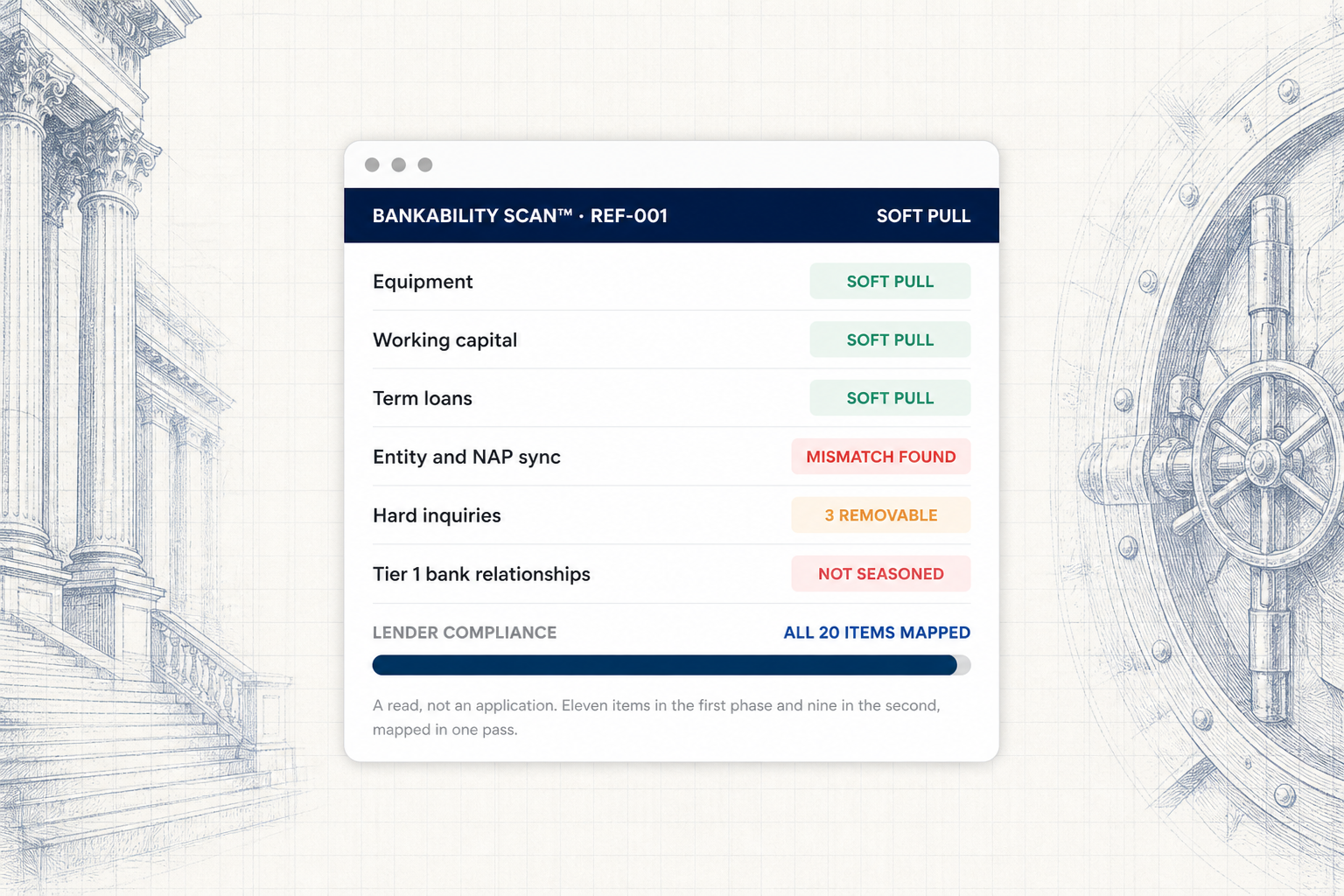
If you want the file read the way a bank reads it, that is what the Bankable Scan™ does.
17. Compliance
This article is educational. It describes public product pages and general planning methods. It is not credit, legal, tax, or financial advice, not a lending offer and not a promise of approval or of any result. Results vary by file. Stacking Capital runs a 1:1 business credit and bank-readiness coaching program. We are not a bank, a lender, or a broker.
Terms change. Fees, rates, offers and reward rules cited here are current as of November 26, 2026 and can change without notice. Dollar examples and owner scenarios are made-up illustrations, not quotes or projections.
Approval is not guaranteed. Typical bank small-business cards from the five Tier 1 issuers still collect owner identity details and a personal guarantee. Confirm the current terms on each issuer's page before you apply or close an account.
Sources: Chase, Ink Business Unlimited; Chase, Ink Business Preferred; Chase, credit card product changes guide; Chase, do points expire; Chase, Ultimate Rewards program agreement; American Express, business card comparison; American Express, Membership Rewards terms; U.S. Bank, Triple Cash Rewards Visa Business Card; Bank of America, Business Advantage Unlimited Cash Rewards; Wells Fargo, Signify Business Cash; NerdWallet, what happens when a 0% intro APR ends; NerdWallet, Amex Blue Business Plus review; Nav, the right way to close a business credit card.
Schedule your Bankable Blueprint Call
Bring your card list, your fee dates and your window end dates. We map which cards stay, which change and which wait.
The Bankable Scan™ reads the personal and business file the way a bank does. The Bankable Blueprint™ writes the order: compliance items, bureau capacity, the 0% doors that fit the file now, and the exit plan before the window closes. 0% is the start. Bankable is the process.
Book a Bankable Blueprint Call