Library · Funding strategy

The Ascension Model. Bank capital comes before equity.

Stacking Capital is the 1:1 capital advisory that treats bank capital as the foundation: the file is made bankable, 0% intro capital and bank lines are leveraged, then stacked bank capital. Equity is fine. It just is not step one.

The short answer

It is an ascension model

It is an ascension model. Bank capital is foundational, and nobody is beyond it. Before you raise equity or venture and give up ownership, the foundation should be in order: personal credit optimized, the business made bankable, 0% intro capital and bank lines of credit leveraged, then stacked bank capital (lines, term loans and SBA). Equity is fine. It just is not step one.

Owners who are already raising a round often treat bank financing as something they have outgrown. Stacking Capital’s position is the opposite. Shouldn’t your foundation be in order first? A bank that can approve the file inside its own policy, without an exception, is not a consolation prize for companies that failed to raise. It is the base the rest of the stack stands on.

Nobody is saying these cannot run in tandem. A sequenced 0% round, a bank line and an equity conversation can sit on the same calendar. What the model refuses is selling stock as the first move while the personal file, the entity and the banking relationships are still unprepared.

None of that is a promised amount, rate or date. Approvals, limits and terms are decided by the institutions and depend on what is actually on the file. Stacking Capital is not a bank, a lender or a broker, and it is not a credit stacking company. This guide is educational. It is not legal, tax or investment advice.

The five rungs, in order

Bank capital first. Equity last.

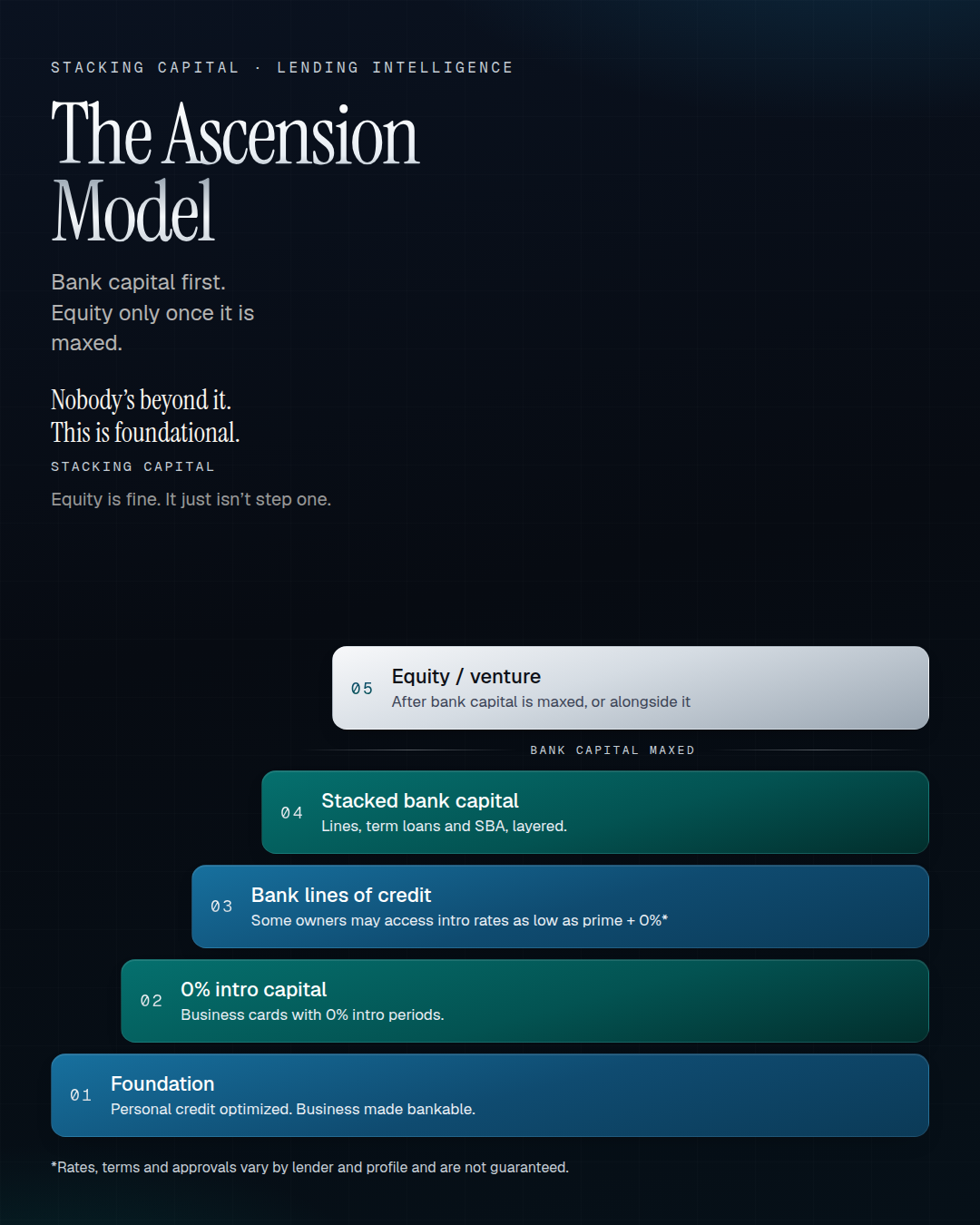
The Ascension Model. Five rungs from foundation to equity. Bank capital first. Equity only once it is maxed. Rates, terms and approvals vary by lender and profile and are not guaranteed.

Stacking Capital Lending intelligence

The Ascension
Model

Bank capital first. Equity only once it is maxed.

Nobody’s beyond it. This is foundational.

Stacking Capital

Equity is fine. It just isn’t step one.

  1. FoundationPersonal credit optimized. Business made bankable.
  2. 0% intro capitalBusiness cards with 0% intro periods.
  3. Bank lines of creditSome owners may access intro rates as low as prime + 0%*
  4. Stacked bank capitalLines, term loans and SBA, layered.
  5. Equity / ventureAfter bank capital is maxed, or alongside it

*Rates, terms and approvals vary by lender and profile and are not guaranteed.

Save / share this graphic1080×1350 · for advisors to send

Why nobody is beyond bank capital

This is foundational

The owners this page is for are often the ones who look, on paper, like they have moved on: a priced round, a term sheet, a conversation with a fund. The instinct is to skip the bank work and go straight to selling stock. Stacking Capital’s line on that is short. Nobody’s beyond it. This is foundational.

Foundation here is not a slogan. It is the file a lender can approve without writing an exception for you. The entity agrees with itself everywhere a bank checks it. Personal credit is prepared rather than merely good. Business credit has started to report. The twenty lender compliance items are clear. The financials say what the returns say. That is the Four Legs of Bankability, and it is rung 01.

A company can be growing and still be unbankable. Revenue does not excuse a mismatched address, an unprepared personal profile or a business file with nothing reporting. Those are the quiet reasons a later desk, bank or investor, prices doubt into the deal or walks.

What each rung actually is

Order carries most of the outcome

01 · Foundation

Personal credit optimized. The business made bankable. This is the work in how to become bankable: read the file the way a lender reads it, make the entity agree with itself, clear the twenty items, build the business file and put the financials in an order an underwriter can follow. Nothing is filed yet. The foundation is what every later rung stands on.

02 · 0% intro capital

Business cards with 0% introductory periods, sequenced in the order the banks reward. This is the cheapest capital these programs offer and it is where most prepared files start. Credit stacking is the tactic on this rung: layering cheap capital before expensive capital. It holds when the profile underneath is bankable and the next round is designed before the intro period ends. The full map of how those products read a file is in the 0% interest business funding guide.

03 · Bank lines of credit

Revolving capital from a traditional bank, sized against the entity rather than against a card limit. Nothing about a line expires with a promotional period the way a 0% card does. Some business owners can access intro or promotional rates on a line as low as prime + 0%*. That is an intro or promotional rate some files may be able to reach. It is not a standing rate, not a promised rate and not an offer Stacking Capital makes. *Rates, terms and approvals vary by lender and profile and are not guaranteed.

04 · Stacked bank capital

The same prepared file, layered: lines, term loans and SBA. Term loans price on time in business, reported history and cash flow, and they build installment history a revolving round cannot. SBA is the longest money on the file, underwritten on the strength of the business itself. This is what the compliance work and the first rounds were quietly preparing for. See the SBA loan products guide and the bankability foundation.

05 · Equity / venture

Equity is fine. It just is not step one. Selling stock, taking a priced round or talking to venture can be the right tool after bank capital is maxed, or alongside it. The divider on the staircase is the point: bank capital maxed, then equity. Not equity first because the raise feels more sophisticated.
Why bank capital is non-dilutive

You keep the ownership

Bank capital is debt. You borrow it, you use it, you repay it. The ownership of the company does not change. That is what non-dilutive means in this model: the capital does not buy a percentage of the business.

Equity and venture do the opposite, on purpose. An investor buys a share. That can be the right trade: a partner, a network, a check larger than a bank will write on the file as it stands. It is also permanent. A point of ownership sold to skip the bank work is a point you do not get back when the file could have carried a line or a term loan without it.

The model is not an argument against equity. It is an argument about sequence. Shouldn’t your foundation be in order first? Then the equity conversation, if you still want it, is a choice rather than a rescue.

Why a bankable file helps with investors later

The same things, read by a different desk

Investors look for many of the same things that make a business bankable. An entity that agrees with itself. Personal and business credit that can be read. Financials that match the returns. A use of proceeds that is not a hole. A company that already has a banking relationship is easier to diligence than one that has never been underwritten.

That is why the two can run in tandem. Making the file bankable is not a detour from a raise. It is work a later investor will thank you for, because the same facts that clear a bank’s policy are the facts a fund reads when it decides whether the story holds. A bankable file does not replace a pitch. It makes more than one desk able to say yes.

The written plan for that work is the Bankable Blueprint. The Bankable Scan™ reads the file the way a bank does. Nothing here is a promised amount, rate or date.

8 questions

Asked alongside
the main one.

01

What is the Ascension Model?

The Ascension Model is Stacking Capital’s order of capital: foundation first (personal credit optimized and the business made bankable), then 0% intro capital, then bank lines of credit, then stacked bank capital (lines, term loans and SBA). Equity and venture sit above a divider marked bank capital maxed. It is an ascension model. Nobody is beyond it. This is foundational.

02

Does raising equity mean I am past bank financing?

No. Bank capital is foundational, including for owners who are raising equity, selling stock or talking to venture. The two can run in tandem. The question Stacking Capital asks is whether the foundation is in order first: a file a bank can approve inside its own policy, before ownership is given up.

03

Why is bank capital non-dilutive?

Bank capital is debt. You repay it. You keep the ownership. Equity and venture sell a share of the company. That can be the right tool for the right chapter. It is an expensive first move when the file could have carried a line, a term loan or SBA without giving up a percentage of the business.

04

Can bank capital and equity run at the same time?

Yes. Nobody is saying these cannot run in tandem. A sequenced 0% round, a bank line and an equity raise can sit on the same calendar. What the model refuses is treating equity as step one while the personal file, the entity and the bank relationships are still unprepared.

05

What does prime + 0% mean on a bank line of credit?

Some business owners can access intro or promotional rates on a bank line as low as prime plus zero percent. That is an intro or promotional rate, not a standing rate and not an offer Stacking Capital makes. Rates, terms and approvals vary by lender and profile and are not guaranteed.

06

Does being bankable help with investors later?

Yes. Investors look for many of the same things that make a business bankable: an entity that agrees with itself, prepared personal and business credit, clean financials and a file a third party can underwrite. A bankable file does not replace a pitch. It makes the company easier to fund from more than one desk.

07

Where does 0% intro capital sit on the model?

On the second rung, after the foundation and before bank lines. A sequenced 0% round is where most prepared files start their funding. It is cheap capital with a clock on it, which is why the next rungs have to be designed before the intro period ends. Credit stacking is a tactic on this rung. Bankable is the outcome underneath it.

08

Is this legal, tax or investment advice?

No. This guide is educational. It describes how Stacking Capital orders capital and how underwriting reads a file. It is not legal, tax or investment advice, and it is not a substitute for your own counsel, accountant or registered advisor.

The position.Equity is fine. It just is not step one.

The Bankable Blueprint™ · 1:1 capital advisory for established business owners

Book a Bankable Blueprint Call