The take
Chase Ink Business Cash has no annual fee, a 0% window for 12 months and a $750 bonus. It pays 5% on the first $25,000 a year at office supply stores and on internet, cable and phone, and 2% on the first $25,000 at gas stations and restaurants. Whether it beats a flat 1.5% card comes down to your own spend mix. Run the math before you apply.
- ✓The facts. Chase's offer page shows $750 cash back after $6,000 of purchases in the first 3 months, a $0 annual fee and 0% for 12 months on purchases. After that the rate is variable, from 16.99% to 24.99% at today's Prime of 7.00%.
- ✓The dollars. On a made-up $90,000 of yearly spend, with $12,000 at office and phone vendors and $18,000 at gas and restaurants, Ink Cash earns $1,560. A flat 1.5% card earns $1,350. On $57,000 of mostly other spend, Ink Cash loses by $125.
- ✓The catch. Chase says the bonus may not be available if you have ever had this card or any other Chase for Business card without an annual fee. Choose which no-fee Ink card goes first.
- ✓Same file. Same banks. Different order. In the Bankable Blueprint™, Chase is one of five Tier 1 issuers opened on the same day in each round. Typical bank small-business cards still collect a personal guarantee, and an EIN or LLC does not remove it.
2. The card on one page
Here is every number that matters, from Chase's own page unless a third party is named. Terms change, so check the offer in front of you on the day you apply.
| Feature | What the sources show | What it means in dollars |
|---|---|---|
| Annual fee | $0 | Keeping the card open costs nothing |
| Sign-up bonus | $750 after $6,000 of purchases in the first 3 months | $2,000 a month of normal spend for 3 months, and the bonus equals 12.5% of that spend |
| 0% window | 0% for 12 months from account opening on purchases | A $20,000 purchase costs $0 in interest during the window if you stay current |
| Rate after the window | 16.99% to 24.99% variable, tied to Prime plus a spread, with a 29.99% ceiling | About $141.58 to $208.25 a month in interest on each $10,000 left |
| 5% category | Office supply stores; internet, cable and phone services. First $25,000 combined per account anniversary year, then 1% | Up to $1,250 a year at the 5% rate |
| 2% category | Gas stations and restaurants. First $25,000 combined per account anniversary year, then 1% | Up to $500 a year at the 2% rate |
| Everything else | 1% with no cap | $1,000 on $100,000 of other spend |
| Employee cards | No additional cost | Add staff cards without adding fees |
| Foreign transaction fee | 3% of each transaction in U.S. dollars, per Forbes Advisor and CNBC | $150 on $5,000 spent abroad |
| Rewards form | Cash back is tracked as points, 100 points per $1, per Chase | 1 point equals 1 cent, per NerdWallet |
Read the table once, slowly. Three items drive most of the decision: the category caps, the 1% on everything else, and the 0% window. The rest is detail.
Chase says the 5% is made of 1% base cash back plus 4% extra, and the 2% is 1% base plus 1% extra. After you hit $25,000 in a category group in an account year, those purchases earn 1%. The year starts on your account anniversary, not on January 1. So a card opened in March resets in March.
3. The $25,000 math, owner by owner
The fair test is against a flat card. Chase's own Ink Business Unlimited pays 1.5% on every purchase with a $0 fee. So ask a simple question: does Ink Cash beat 1.5% on my spend?
Here are three made-up owners. Each shows yearly spend by group, what Ink Cash earns, and what a flat 1.5% card earns.
| Owner | Office and phone | Gas and restaurants | Everything else | Ink Cash earns | Flat 1.5% earns | Ink Cash gain or loss |
|---|---|---|---|---|---|---|
| A. Office-based services firm | $12,000 | $18,000 | $60,000 | $1,560 | $1,350 | Gain $210 |
| B. Light spender | $3,000 | $4,000 | $50,000 | $730 | $855 | Lose $125 |
| C. Heavy in both groups | $30,000 | $40,000 | $30,000 | $2,250 | $1,500 | Gain $750 |
Look at how Owner C gets there. The office and phone group is $30,000, but only the first $25,000 earns 5%. That is $1,250. The last $5,000 earns 1%, or $50, for $1,300. Gas and restaurants is $40,000. The first $25,000 earns 2%, or $500. The last $15,000 earns 1%, or $150, for $650. The other $30,000 earns $300. Total: $2,250.
Owner B shows the other side. Bonus categories are small, so the 1% on $50,000 drags the total down. A flat card wins by $125. If you are Owner B, the Ink Cash bonus may still make year one worth it, but year two is a loss.
What counts as an office supply store or a phone bill
Chase names the categories but does not list every merchant, and Forbes Advisor makes the same point. So treat the first 90 days as a test. Pull your statement and look at what posted at 5%. If your main supplier does not code as an office supply store, move that spend to a flat card.
A practical step: list your ten biggest vendors. Mark each one as office supply, internet, cable or phone, gas, restaurant or other. Add up the year. That list is the whole answer to "should I apply?"
The total cap
Between the two groups, the most you can earn at bonus rates is $25,000 at 5% plus $25,000 at 2%, or $1,750 on $50,000. Bankrate notes that boosted rewards are capped at $50,000 per year. A business that spends far more should plan to move extra spend to another card once it hits a cap.
4. The $750 bonus and its fine print
Chase's page offers $750 cash back after you spend $6,000 on purchases in the first 3 months after account opening. Plan for it, but do not bend your business around it.
What counts toward the $6,000
Chase says balance transfers, cash advances, cash-like transactions, lottery tickets, casino chips, race track wagers, person-to-person transfers, checks that access the account, interest, unauthorized charges and fees of any kind do not count. Ordinary business purchases do.
Here is the pace. $6,000 over 3 months is $2,000 a month, or about $462 a week. If your business already spends that on supplies, ads, software and fuel, the bonus is free. If it does not, do not buy things you do not need. A $750 bonus is not worth $6,000 of spending you would not make.
When the bonus posts
Chase says to allow 6 to 8 weeks after you qualify. The account must be open and not in default when the bonus is paid. So do not close the card the week you hit the spend.
The eligibility catch
This is the line most owners miss. Chase says the bonus may not be available if you have ever had this card or any other Chase for Business card without an annual fee. Ink Business Unlimited is also a no-fee Chase business card. So if you open Unlimited first, the Cash bonus may not be there for you later. And the reverse can be true.
What should you do about that? Decide, before you apply, which no-fee Ink card earns the bonus that fits your spend. Chase may also look at factors specific to your business. If a Chase banker or the issuer's page says otherwise for your offer, follow that.
5. The 0% window, in dollars
The 12-month 0% window is the part that matters most to the Blueprint. It runs from account opening, not from your first purchase. So the clock starts the day the account opens.
Here is what that means for a made-up $20,000 purchase made in the first month, say for equipment or inventory.
| Item | Amount |
|---|---|
| Interest during the 12-month window | $0 |
| Monthly payment at 1% of the balance | $200 |
| Monthly payment at 1.5% of the balance | $300 |
| Payment needed to clear $20,000 in 12 months | $1,666.67 |
| Interest in the first month after the window on any $10,000 left, at 16.99% | $141.58 |
| Same, at 24.99% | $208.25 |
The lesson is the same one the Blueprint keeps teaching. 0% does not mean zero monthly payment. You still owe a payment each month. Many owners budget the $200 or $300 and forget the $1,666.67 that clears the balance. Then the window ends and the interest begins.
Build the exit on day one. Our 0% exit plan shows how, and the monthly payment system keeps the dates straight across several cards. Read your cardmember agreement for the exact minimum payment on your card.
After the window, you have choices. Keep the card for the category rewards, change it, or close it. Our guide on what to do with each card after the 0% window walks through them. For Ink Cash the answer is usually to keep it, since the fee is $0 and the category rewards pay for themselves if your spend fits.
6. Applying: pulls, guarantee and limits
The hard pull
Chase's education page says issuers typically perform a hard inquiry on your personal credit report when you apply for a business card with personal liability. Plan for it. A hard inquiry can lower a score by a few points for a short time, per Chase.
The personal guarantee
Chase's page on business cards and personal credit says a personal guarantee is a common requirement. That matches the Blueprint. Typical bank small-business cards at Chase, Amex, U.S. Bank, Bank of America and Wells Fargo still collect owner identity details and a personal guarantee. An EIN or an LLC does not remove it. If you see an offer that claims otherwise, confirm on the issuer's page.
What does a guarantee mean in dollars? If the business cannot pay a $15,000 balance, you can be asked to pay it. So size your spend to what the business can repay, not to the limit.
The credit profile
Third-party reviews list the target as good to excellent credit. CNBC shows a range of 670 to 850. Those ranges are guides, not rules, and Chase may use another scoring model. Before you apply, run the pre-application checklist.
The starting limit
Chase does not promise a limit. NerdWallet reports that Chase's stated minimum starting limit is $1,100. Your limit depends on your file. Two things help a limit: a clean personal file, and business details that match across your documents. Our limit methodology guide explains how issuers set it.
Chase's page also says cardmembers are automatically checked for a credit line increase at least every 6 months. That is a check, not a promise. Pay on time, in full, and use the card.
How many Chase cards, and how fast
Owners ask whether Chase caps business cards or sets a waiting rule. Chase does not publish a fixed card maximum, and the common timing patterns are not Chase rules. Our pages on how many Chase business cards you can have and whether Chase business cards count toward 5/24 cover it. Count the accounts on your own reports, and do not rely on a shortcut.
7. What it does to your personal file
This is where owners get hurt by guessing. Chase's own education page says business cards with personal liability may share account information with credit bureaus. It also says whether that happens depends on the issuer and the type of card. And it suggests you check with your specific issuer.
So here is the owner-first version. Do not assume the card is invisible to your personal file. Pull your personal reports after the card opens. See whether it appears. If it does, its balance counts in your personal utilization. If it does not, it does not. Either way, the best habit is the same: pay the statement balance in full, and keep the balance low when the statement posts.
Our guide on which business cards pull and report to business bureaus keeps the current detail by issuer. Link it to your file notes.
| Balance at statement | Limit | Utilization on this card |
|---|---|---|
| $15,000 | $20,000 | 75% |
| $6,000 | $20,000 | 30% |
| $1,000 | $20,000 | 5% |
If the card does show up, the first row is a problem and the last row is not. If it does not show up, none of the rows matter for your personal score. You only learn which by looking. That is why the reports come first.
8. The extras, priced
Chase lists several extras on the offer page. Here is what each means for an owner.
- Purchase Protection. Eligible new purchases are covered against damage or theft for 120 days from purchase, up to $10,000 per item (90 days for New York residents). A $4,000 laptop stolen in month three is a claim, not a loss, if the terms apply.
- Auto rental coverage. If you decline the rental company's collision insurance and charge the whole rental to the card, coverage is primary for business rentals, up to $60,000, for vehicles with an MSRP of $125,000 or less. Restrictions apply. Read the benefit guide before you rely on it.
- Extended warranty. It adds one year to eligible manufacturer warranties of three years or less, up to four years from purchase. On a $6,000 machine, that is a year of cover you did not buy.
- Lyft. Chase shows 5% total cash back on qualifying Lyft products through September 30, 2027. On $2,000 of Lyft rides that is $100, against $20 at the 1% base rate.
- Instacart+. A free three-month membership, which renews at $99 a year after the free period if you do not cancel, per Chase. Put a reminder on your calendar.
- Employee cards. They cost nothing extra. They can have their own limits. The business and the authorizing officer remain responsible for all balances.
The employee card point deserves a second look. Staff cards help you route office and phone spend through the 5% group. They also add risk. Set a limit on each card, and review the statement monthly.
9. Pairing it with another card
NerdWallet's advice is to pair Ink Cash with another card. Here is why it works, in dollars. Use Owner A from earlier: $12,000 office and phone, $18,000 gas and restaurants, $60,000 other.
| Setup | How spend is routed | Yearly rewards |
|---|---|---|
| Ink Cash only | Everything on Ink Cash | $1,560 |
| Ink Unlimited only | Everything on a flat 1.5% | $1,350 |
| Both | Office, phone, gas and restaurants on Ink Cash. Everything else on Ink Unlimited | $1,860 |
The pair beats Ink Cash alone by $300 and the flat card alone by $510. The only cost is the work of using the right card in the right place. For a business with an owner who buys most things, that is easy. For a business with ten employees on ten cards, it takes rules.
The transfer-partner angle
Ink Cash earns Chase Ultimate Rewards points. CNBC and Forbes both note that pairing it with a Chase card that allows transfers, such as Ink Business Preferred, can raise what the points are worth. That is real, but it adds a fee card and some complexity. If you do not travel on points, leave it. Cash back is cash back.
One more caution on the bonus rule from section 4. If a no-fee Chase business card limits the bonus on another no-fee card, open the card that fits your spend first, and let the bonus follow.
10. The rate after 0%, and the December Fed meeting
Chase shows the ongoing rate as the lesser of Prime plus a spread and 29.99%. Prime is 7.00% today, so the low end is 16.99% and the high end is 24.99%. When Prime moves, the rate moves.
The Fed meets December 8 to 9, and the market expects a quarter-point hike. We cover that in our November 25 note. On a card, the change is small. A quarter point on a $10,000 balance is $2.08 a month. The bigger number is the rate itself: $141.58 to $208.25 a month on each $10,000, before any hike.
So the Fed is not the reason to avoid carrying a balance. The rate is. Pay in full, or have a dated plan to clear the balance before the window ends.
Foreign spend
The 3% foreign transaction fee reported by Forbes Advisor and CNBC cuts hard into a 1% reward. On $5,000 of spend abroad, the card pays $50 in cash back and charges $150 in fees. That is a net loss of $100. If you buy from overseas suppliers, use a card without that fee, and confirm the fee on your own cardmember agreement.
11. Where it fits in the three rounds
The Blueprint stacks cards in same-day rounds, not one at a time. Round 1 is Month 3, with all five Tier 1 issuers on the same day. Round 2 is Months 7 to 8 with four issuers, skipping Wells Fargo. Round 3 is Months 11 to 12 with all five again. The five are Chase, American Express, U.S. Bank, Bank of America and Wells Fargo.
Where does Ink Cash fit? Usually in Round 1, as the Chase card. The 0% window opens the same day as the other four, so you can plan all five exits on one calendar. That is the point of same-day rounds. Same file. Same banks. Different order.
Which Chase card goes first? That depends on the bonus rule in section 4 and on your spend. A business heavy in office and phone spend may lead with Ink Cash. A business with scattered spend may lead with Ink Unlimited. Our guides on why Round 1 is same-day and what to do between rounds explain the timing.
The four Legs of Bankability sit under all of this: lender compliance, business credit scores, ten to fifteen trade lines and financials. A card is one input. It does not replace any Leg. Read how banks check compliance before you apply, because a mismatch in names or addresses can slow a card as easily as a loan.
- Before you apply List your ten biggest vendors by category and total the year. Decide which no-fee Chase card should take the bonus.
- Day of approval Write the account opening date. That starts the 12-month window and the account year.
- Months 1 to 3 Track spend toward $6,000 using purchases you would make anyway.
- Week 6 to 8 after the spend Look for the bonus to post. Do not close the account before it does.
- Month 9 Write the payoff plan. Divide the balance by the months left.
- Month 12 The window ends. Pay the balance to zero or have a dated plan. Then decide: keep, change or close.
12. Seven mistakes
- Applying for the bonus alone. The bonus is $750 once. The category fit pays every year.
- Ignoring the cap. Spend past $25,000 in a group earns 1%. Move it to a flat card.
- Assuming a merchant codes as an office store. Check the first statement. Move vendors that do not code.
- Opening two no-fee Chase cards without a plan for the bonus. Chase says the bonus may not be available if you held another no-fee Chase for Business card.
- Treating 0% as free money. You still owe monthly payments, and the balance is due when the window ends.
- Using it abroad. A 3% fee wipes out the 1% reward.
- Not checking your personal reports. Whether the card shows on your personal file is a fact you can see in minutes. Look.
13. Questions owners ask
What is the sign-up bonus on Chase Ink Business Cash right now?
Chase's offer page shows $750 cash back after you spend $6,000 on purchases in the first 3 months after account opening. Offers can change, so check the page when you apply.
Does Ink Business Cash have an annual fee?
No. The annual fee is $0, and employee cards cost nothing extra.
What earns 5% on Ink Business Cash?
Office supply stores, plus internet, cable and phone services. The 5% applies to the first $25,000 in combined purchases each account anniversary year. After that, those purchases earn 1%.
Is Ink Business Cash better than Ink Business Unlimited?
It depends on your spend. Unlimited pays 1.5% on everything. Cash pays 5%, 2% and 1%. In the made-up examples in this guide, Cash wins when enough spend lands in the bonus groups, and loses when most spend is other.
Does Chase check my personal credit for a business card?
Chase says issuers typically run a hard inquiry on your personal report when you apply for a business card with personal liability. A personal guarantee is a common requirement. Typical bank small-business cards still collect one, and an EIN or LLC does not remove it.
Will this card show on my personal credit report?
It may. Chase says business cards with personal liability may share account information with credit bureaus, and that it depends on the issuer and card. Pull your own reports to see.
What happens when the 0% window ends?
The regular variable rate applies to any balance left. Chase shows 16.99% to 24.99% as of this writing. On $10,000, that is about $141.58 to $208.25 a month in interest.
14. Open items
- Your own offer. The bonus, the window and the rate can differ by where you apply and when. Read the offer in front of you.
- Bonus eligibility. Chase says the bonus may not be available if you have held this card or another no-fee Chase for Business card. Confirm with Chase before you apply.
- Merchant categories. Chase names the categories, not every merchant. Check how your vendors post on your first statement.
- Minimum payment. The 1% and 1.5% figures here are illustrations. Read your cardmember agreement for the exact formula.
- Foreign transaction fee. The 3% figure comes from Forbes Advisor and CNBC. Confirm in your agreement.
- Personal reporting. Whether the card shows on your personal file is an issuer fact. Check your reports and confirm with Chase.
- Starting limit. The $1,100 minimum comes from NerdWallet's review. Your limit depends on your file.
- All owner examples. Spend, balances and rewards are made up for illustration. They are not quotes or projections.
15. What to do next
- This week List your ten biggest vendors and tag each by category. Total the year for each group.
- This week Run the three-owner math with your own numbers. If Ink Cash does not beat 1.5%, skip it or use it only for the window.
- Before you apply Decide which no-fee Chase card takes the bonus. Pull your personal reports and run the pre-application checklist.
- Day one Write the account opening date, the window end date and the payoff plan on one page.
- Month 9 Divide the remaining balance by the months left. Set autopay for that amount.
- Month 12 Decide keep, change or close with the numbers in hand.
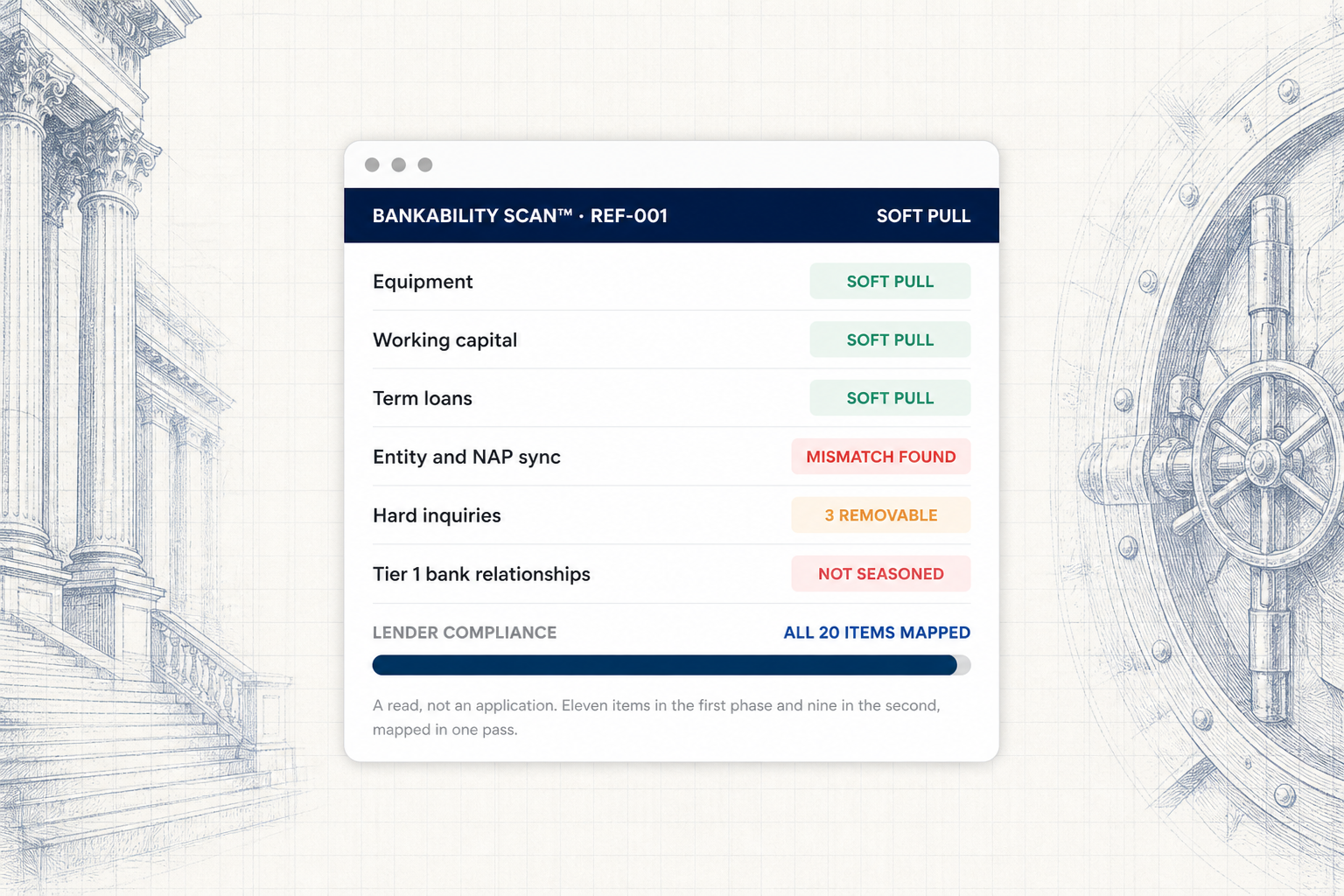
If you want the file read the way a bank reads it, that is what the Bankable Scan™ does.
16. Compliance
This article is educational. It describes public product pages and general planning methods. It is not credit, legal, tax, or financial advice, not a lending offer and not a promise of approval or of any result. Results vary by file. Stacking Capital runs a 1:1 business credit and bank-readiness coaching program. We are not a bank, a lender, or a broker.
Terms change. Fees, rates, offers and reward rules cited here are current as of November 27, 2026 and can change without notice. Dollar examples and owner scenarios are made-up illustrations, not quotes or projections.
Approval is not guaranteed. Typical bank small-business cards from the five Tier 1 issuers still collect owner identity details and a personal guarantee. Confirm the current terms on Chase's page before you apply.
Sources: Chase, Ink Business Cash; Chase, Ink Business Unlimited; Chase, do business credit cards affect personal credit; Chase, how business credit cards may affect your personal credit score; NerdWallet, Chase Ink Business Cash review; Bankrate, Ink Business Cash review; Forbes Advisor, Ink Business Cash review; CNBC Select, Ink Business Cash review; Federal Reserve, H.15 selected interest rates.
Schedule your Bankable Blueprint Call
Bring your vendor list and your card plan. We map which Chase card fits your spend and how it sits in a same-day round.
The Bankable Scan™ reads the personal and business file the way a bank does. The Bankable Blueprint™ writes the order: compliance items, bureau capacity, the 0% doors that fit the file now, and the exit plan before the window closes. 0% is the start. Bankable is the process.
Book a Bankable Blueprint Call